Axial-flux motors and frameless torque motors are the two core technical routes for humanoid robot joint drive today; they differ markedly in topology, performance and industrialization progress, and respectively suit different joint needs and development stages.
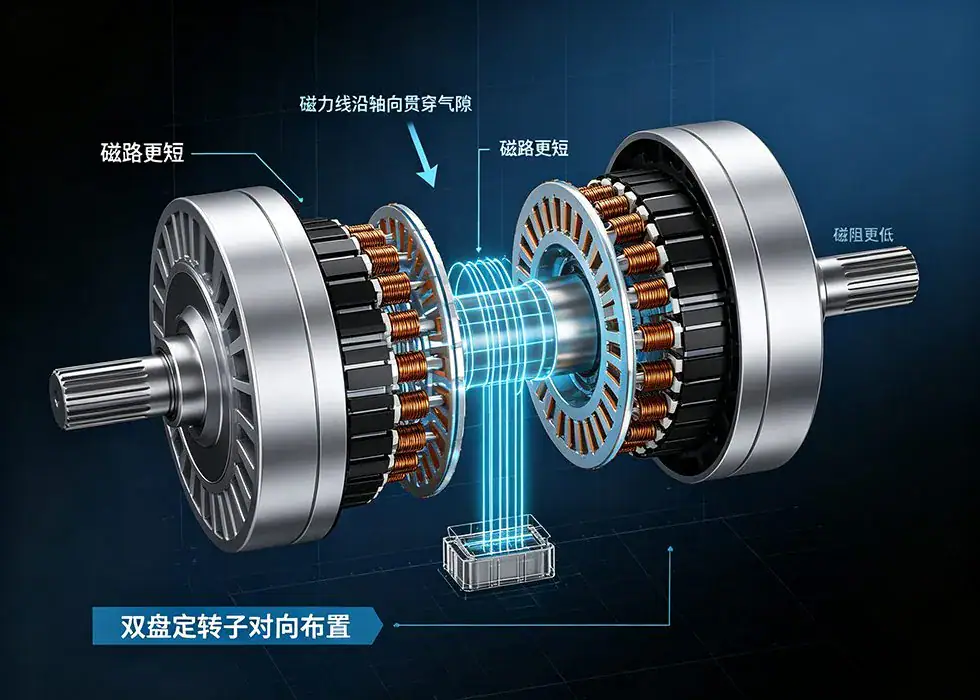
Magnetic Circuit Principle of Axial-Flux Motor
In terms of topology, the flux direction of an axial-flux motor is parallel to the motor shaft; the stator and rotor are arranged as two or more opposing discs with the air-gap field distributed axially, shortening the magnetic path and reducing reluctance losses compared with a conventional radial motor. The frameless torque motor omits the housing, bearings and output shaft of a conventional motor, keeping only the stator and rotor assemblies, and can be embedded directly inside a joint and integrated with the reducer; its working principle resembles a direct-drive motor but with better torque density.
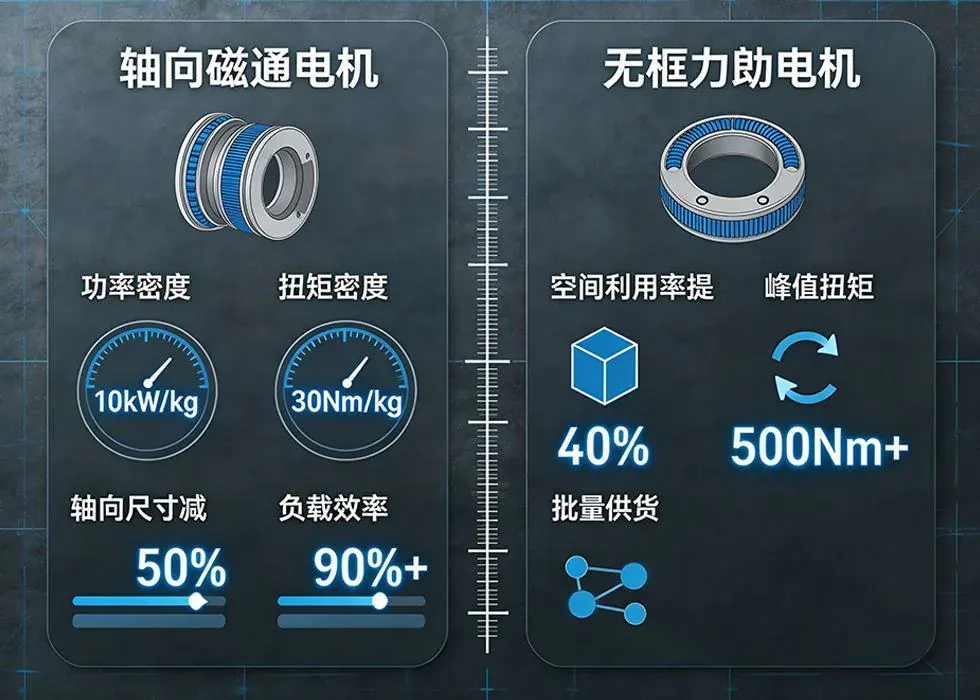
Visual Comparison of Performance Indicators for Two Types of Motors
At the performance level, the core advantage of the axial-flux motor is ultra-high power density and a flat structure. Its power density can reach 10kW/kg and its torque density 30Nm/kg, its axial size is reduced by 50% versus conventional solutions, and its efficiency is above 90% across a 20%-95% load range, making it suitable for the frequent start-stop conditions of humanoid robots and better fitting the space requirements of built-in joints. The advantages of the frameless torque motor centre on high integration and industrial maturity: it is designed in one piece with the joint structure, raising space utilization by over 40% and enabling zero-backlash transmission with peak torque above 500Nm; meanwhile its supply chain is well developed and batch supply has been achieved, making it the current mainstream deployment solution.
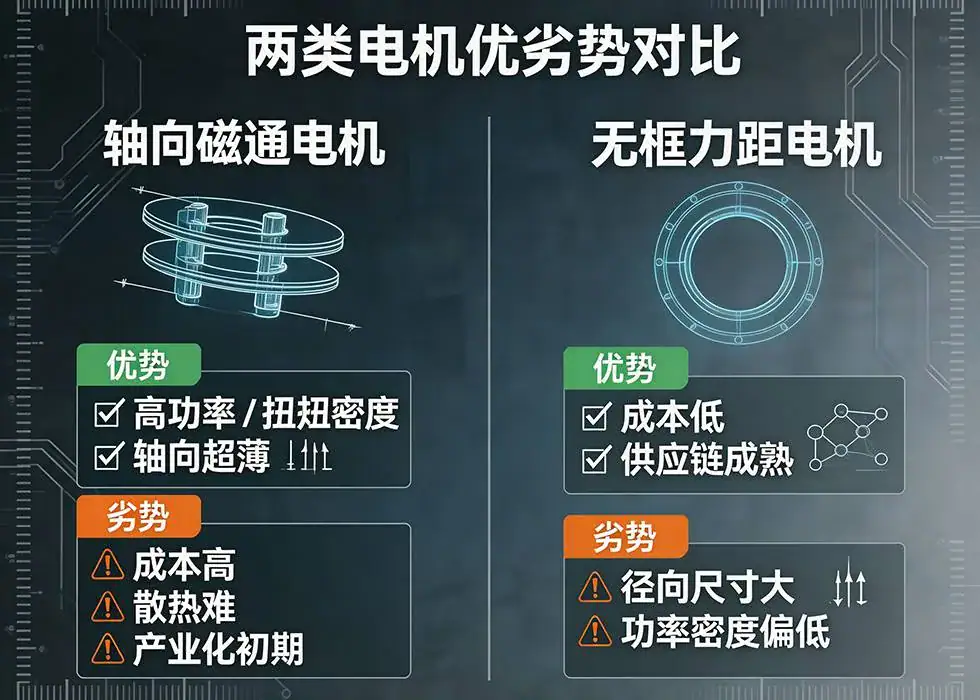
Advantage Comparison Chart
Comparing key indicators, the axial-flux motor leads in power density, torque density and axial size, but costs more and is harder to cool, and its industrialization is still at an early stage; the frameless torque motor has low mass-production cost and a mature supply chain, but its radial size is relatively large and its power density is relatively low.
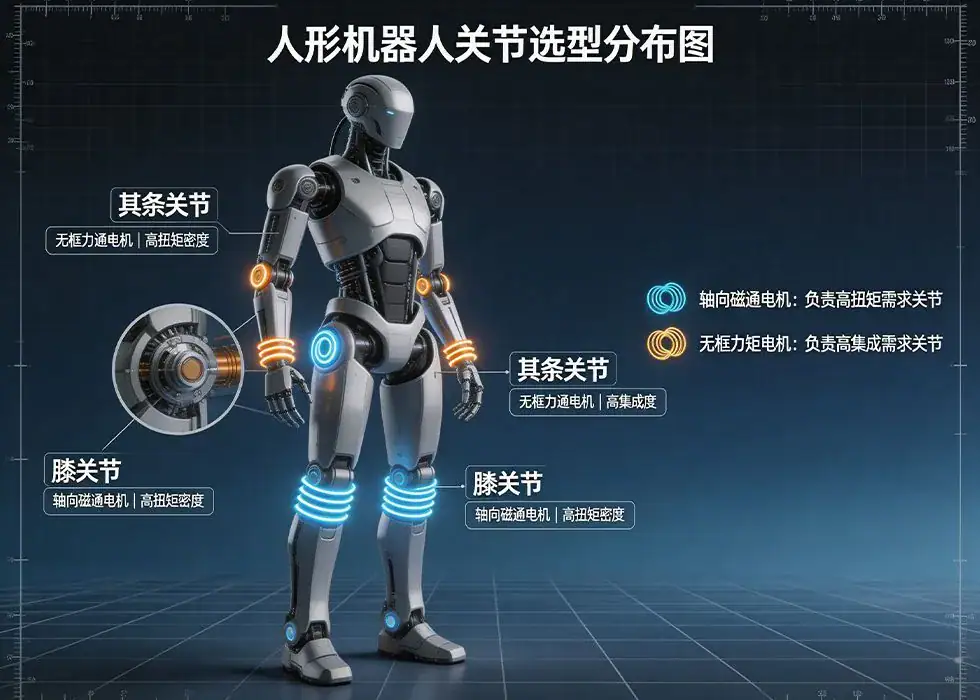
Joint Selection Distribution Diagram of Humanoid Robots
In terms of selection logic, load-bearing lower-limb joints such as the hip and knee better suit the high torque density of axial-flux motors. In the short term, frameless torque motors remain the market mainstream; in the medium and long term, axial flux is expected to form a differentiated replacement in high-torque lower-limb scenarios, and hybrid drive combining the two may also become the industry's endgame. Jiuju has mature technical accumulation in core processes such as stator-rotor magnetizing and precision assembly for both motor types, supporting precision control and mass-production rollout of joint motors and helping advance the industry's technology.
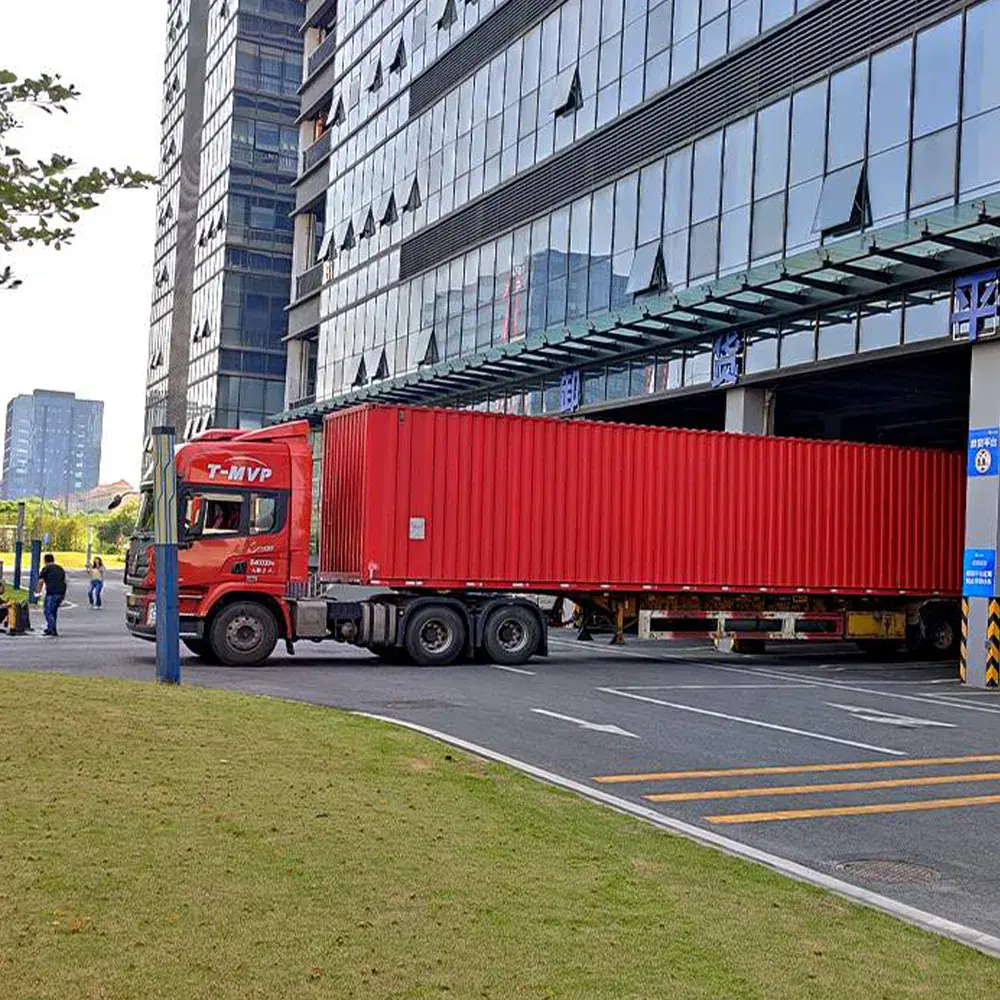
The shipping area outside the workshop was a hive of activity. After multiple rounds of full-machine commissioning, simulated mass-production validation, and factory quality inspection, a Jiuju DC motor automatic assembly line completed all factory-out procedures, was loaded onto trucks on schedule, and is about to depart for the customer's production base, helping the customer's project advance production implementation on plan.
A multi-pole architecture brings a high-frequency fundamental; at 10,000 rpm the fundamental frequency can reach several kHz. Traditional IGBTs suffer soaring switching losses and severe heating — it is the MHz-class switching capability of SiC MOSFETs that truly matches high-frequency multi-pole axial flux motors.
Jiuju Automation provides high-precision automatic assembly lines for axial flux motors, covering processes such as stator winding, magnet assembly, rotor balancing, and final product testing. These lines are suitable for applications in drones, new energy vehicles, and industrial drives. The company holds over 256 patents and is ISO 9001 certified...
Robotic joints require high torque, compact size, and light weight; axial flux motors offer unique advantages in scenarios with limited axial space. This article analyzes their suitability and the challenges involved.
The stator and rotor are separated by a sub-millimeter air gap, and there is an axial attractive force of several metric tons between the magnets on both sides and the iron core. If the force on the air gap becomes uneven, the attractive force on one side increases exponentially, posing a severe challenge to the rigidity of the bearings and the housing.
 Jiuju Automation






 Spanish
 French
 German
 Hindi