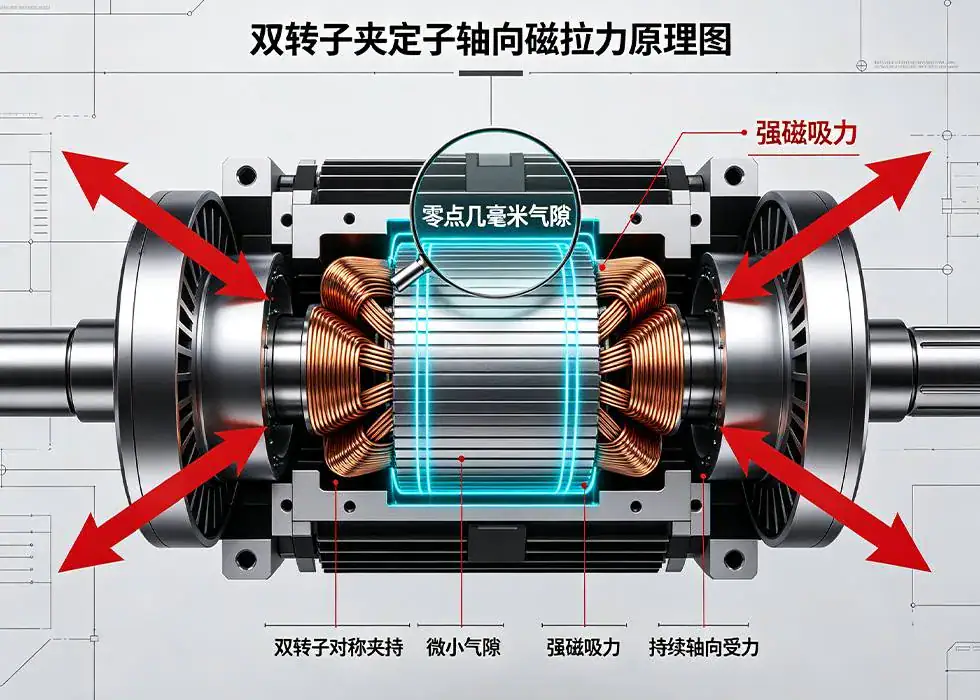
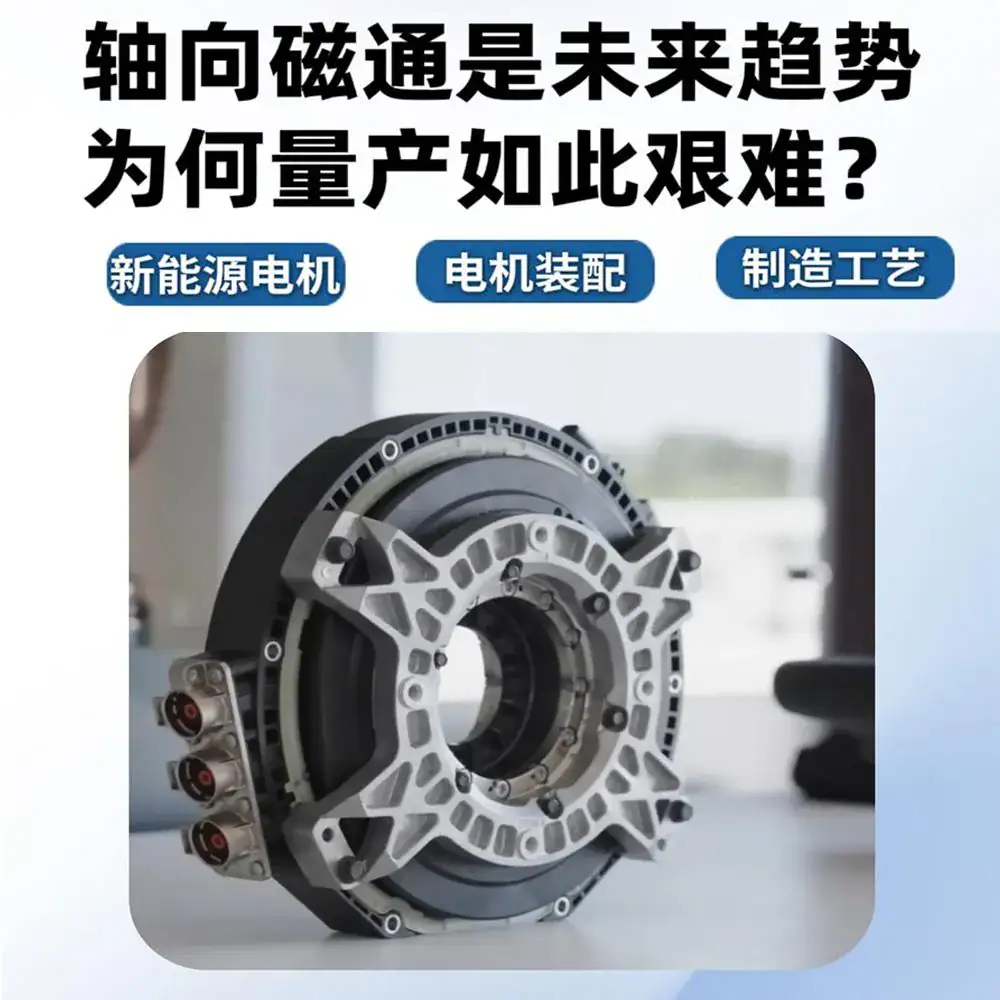
An axial-flux motor's air gap is only a few tenths of a millimetre, yet the magnets' attraction is very strong. When two rotors clamp the stator, the two rotor discs exert a continuous axial magnetic pull on the stator, causing vibration at best and disc rubbing or even seizure at worst. This force must ultimately be borne by the bearing system.
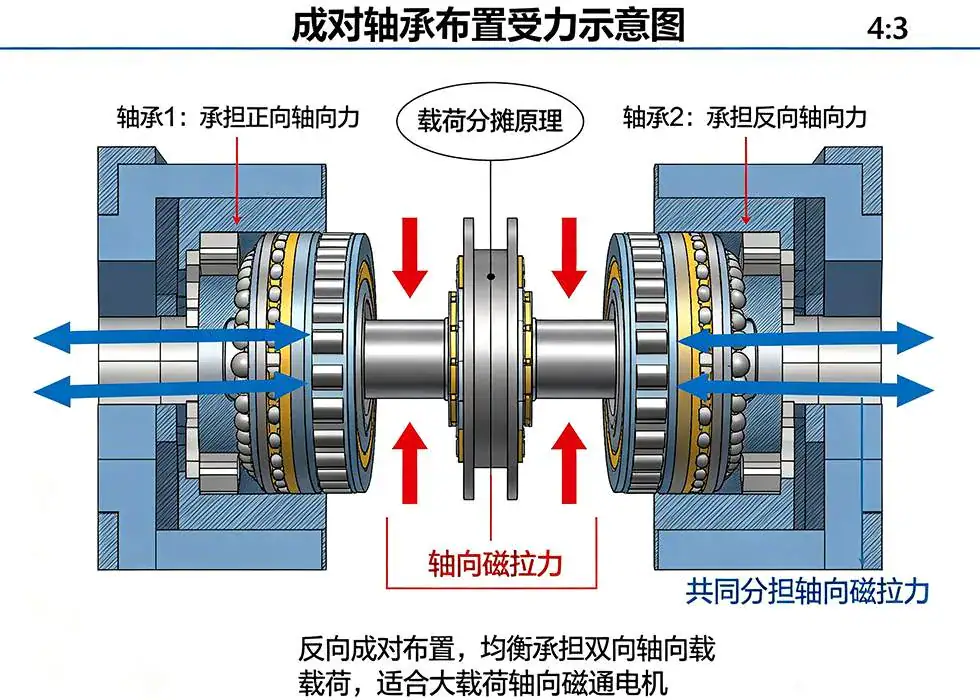
Ordinary deep-groove ball bearings mainly carry radial force and have limited axial load capacity. An axial-flux motor needs bearings that can directly take the axial force — angular-contact ball bearings, thrust ball bearings, or paired arrangements to share the load. When selecting, do not look only at radial speed; axial load is the key item.
Axial Magnetic Force Schematic, Dual-Rotor Clamped-Stator
Preload is another hurdle. If a bearing has clearance, the rotor will move axially as soon as the magnetic pull arrives and the air gap will drift; with appropriate preload, the rotor's axial position is locked and the air gap stays stable. But too much preload raises friction, heat and wear; too little cannot suppress the movement — a middle value must be chosen according to actual conditions. Multi-disc or high-speed scenarios are more sensitive. Axial force varies with speed and temperature, so the preload design must leave margin. Grease and cages also affect stability at high speed; you cannot just fit any one.
Force Schematic of Paired Bearing Arrangement
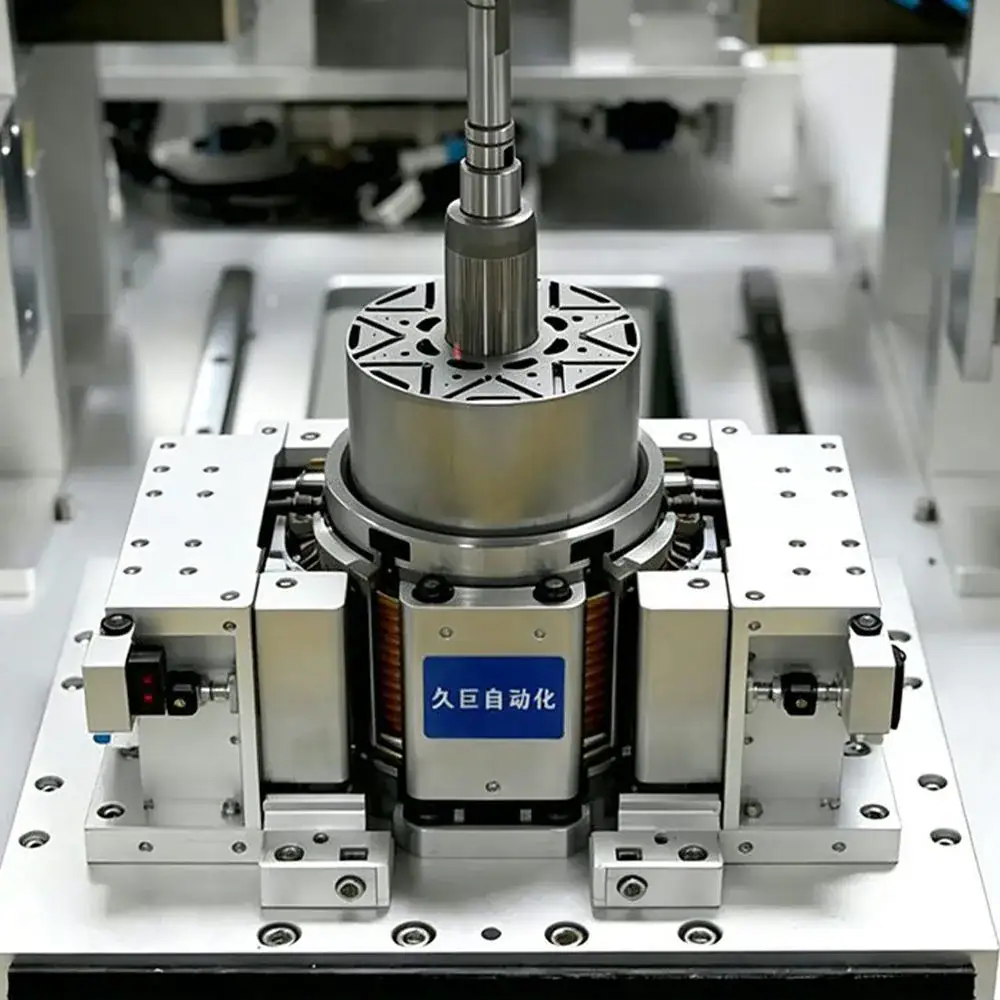
When assembling such lines, Jiuju lists bearing press-fit force, preload and axial clearance as mandatory inspection items, and uses the stator-rotor joining process to lock the rotor's axial position precisely, preventing magnetic attraction from amplifying assembly deviations layer by layer. Bearings for axial-flux motors are not off-the-shelf parts to be picked at random — axial force and preload must be calculated together to truly "catch" the magnetic pull.
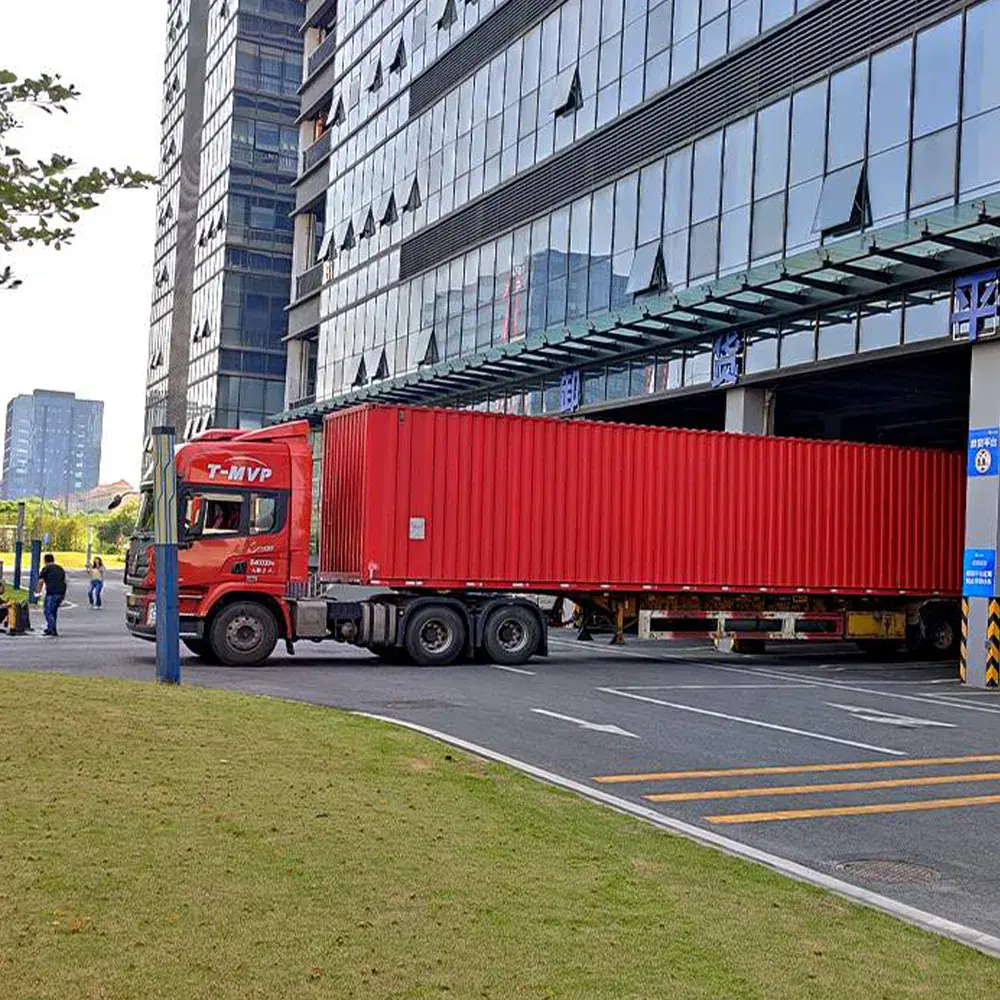
The shipping area outside the workshop was a hive of activity. After multiple rounds of full-machine commissioning, simulated mass-production validation, and factory quality inspection, a Jiuju DC motor automatic assembly line completed all factory-out procedures, was loaded onto trucks on schedule, and is about to depart for the customer's production base, helping the customer's project advance production implementation on plan.
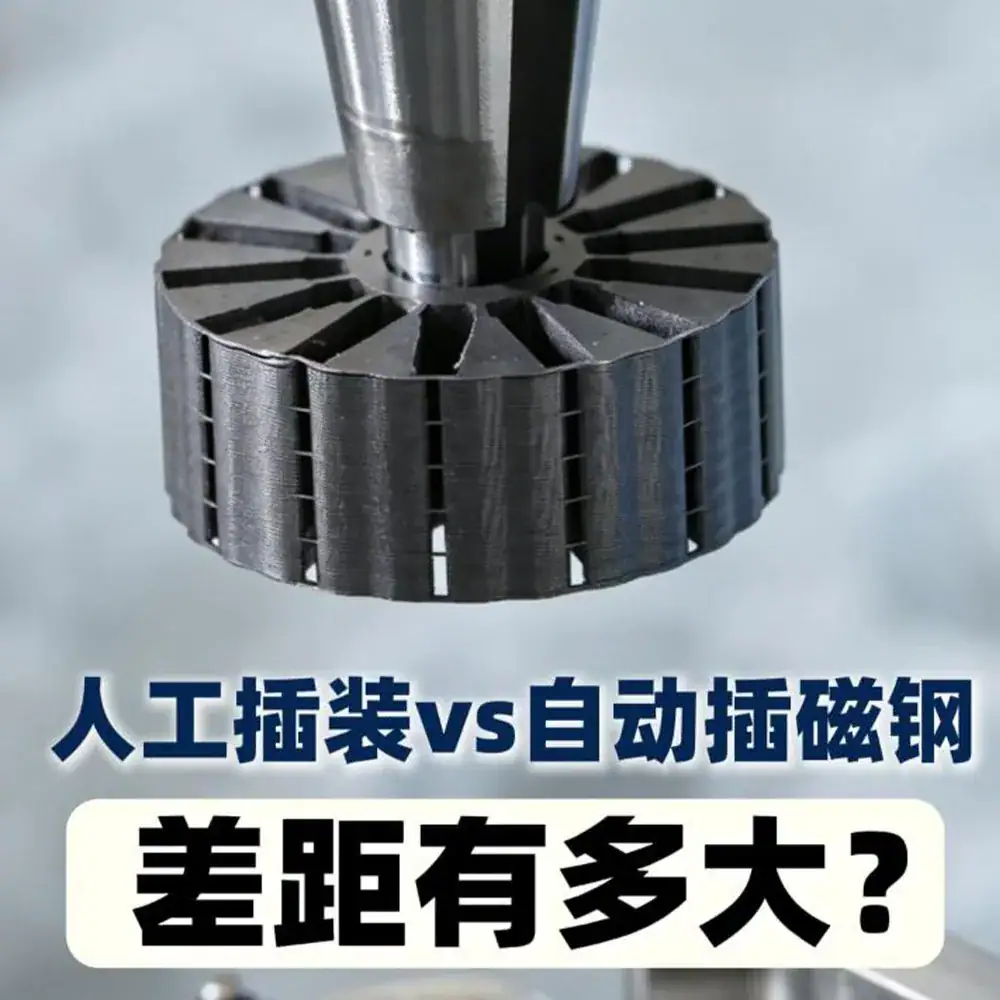
Jiuju Automation provides high-precision automatic assembly lines for axial flux motors, covering processes such as stator winding, magnet assembly, rotor balancing, and final product testing. These lines are suitable for applications in drones, new energy vehicles, and industrial drives. The company holds over 256 patents and is ISO 9001 certified...
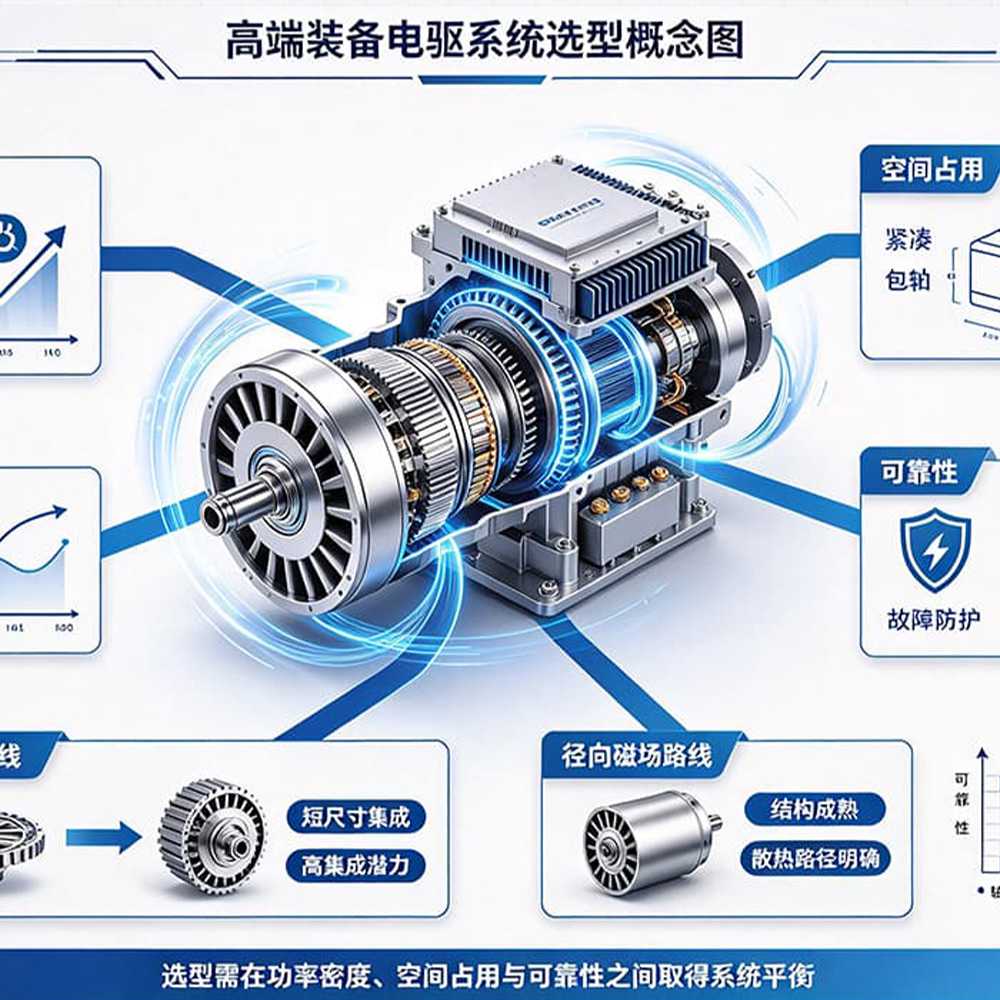
The performance of axial-flux motors is highly dependent on their spatial topology. This article analyzes four fundamental topologies—SSSR, DSSR, DRSS, and multi-disk stacking—as well as innovations in yoke-less and segmented stator designs.
Jiuju Automation provides high-precision automatic assembly lines for axial flux motors, covering processes such as stator winding, magnet assembly, rotor balancing, and final product testing. These lines are suitable for applications in drones, new energy vehicles, and industrial drives. The company holds over 256 patents and is ISO 9001 certified...
A multi-pole architecture brings a high-frequency fundamental; at 10,000 rpm the fundamental frequency can reach several kHz. Traditional IGBTs suffer soaring switching losses and severe heating — it is the MHz-class switching capability of SiC MOSFETs that truly matches high-frequency multi-pole axial flux motors.
 Jiuju Automation







 Spanish
 French
 German
 Hindi