For an axial-flux motor to go high-speed, structural strength is one hurdle, but past strength there is an even more hidden hurdle: dynamic balancing. A disc rotor has a large diameter and high speed; even a slight mass offset will, at high rotational speed, amplify into an obvious centrifugal force fluctuation that finally shows up as vibration and noise.
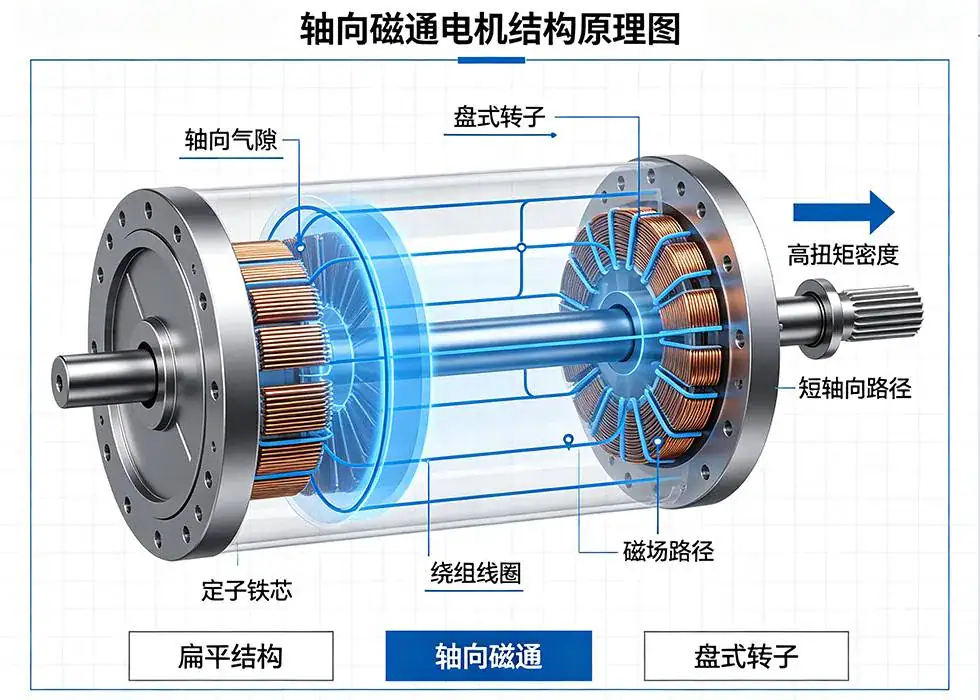
Axial Flux Motor Structure Schematic
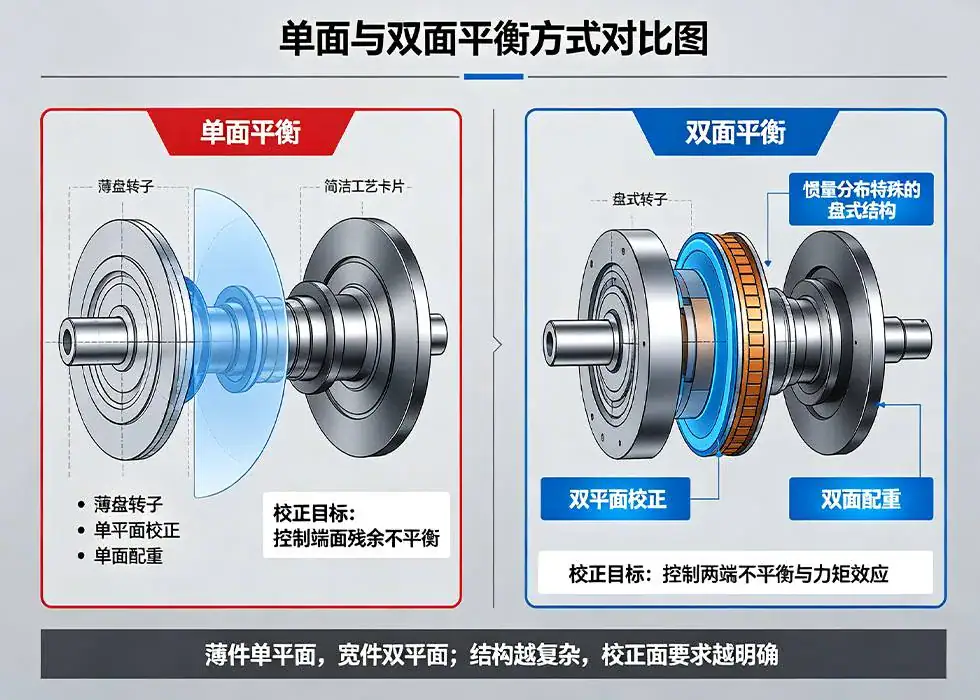
Dynamic balancing looks at the "residual unbalance" — how much mass eccentricity remains once the rotor spins. The industry commonly uses balance grades as a constraint: the stricter the grade, the smaller the residual allowed and the higher the demands on process and inspection. The disc structure is flat with a special inertia distribution, so the balancing method often has to be chosen between single-side and double-side.
Single-side vs Double-side Balancing Comparison Diagram
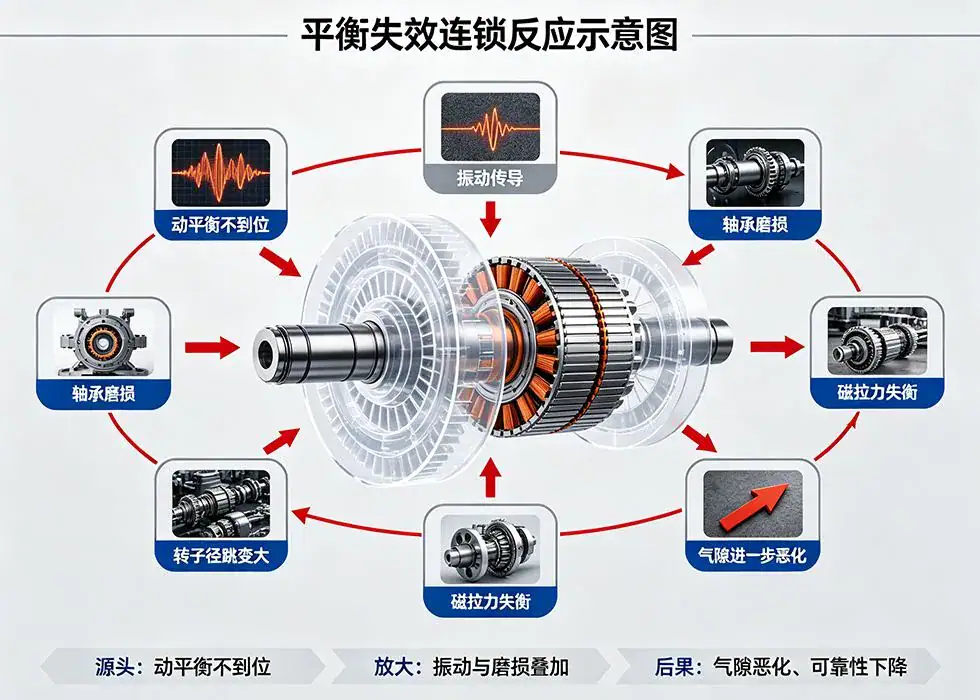
Practical correction comes down to two routes: adding weight or removing weight. Adding weight means adding mass on the light side; removing weight means cutting material from the heavy side. Disc rotors are usually a combination of magnets and a back iron, often wrapped in carbon fibre or a sleeve, so where to add and where to cut must avoid the critical magnetic-circuit and strength zones, or the balance will be fixed but something else will go wrong. This process is directly tied to overall machine performance. If balancing is inadequate, vibration travels along the shaft and housing, making noise and accelerating bearing wear; for an already sensitive air gap, increased rotor radial runout can bring out magnetic-pull imbalance and form a vicious circle.
Balance Failure Chain Reaction Schematic
In high-speed rotor joining, Jiuju builds dynamic balancing into the process rather than fixing it afterwards. First control the coaxiality and face runout of individual parts, then balance at the whole-rotor level — far cheaper than discovering vibration after final assembly and reworking. Dynamic balancing and structural strength are two separate lines: one governs "will it fly apart", the other "will it run smoothly". Only when both pass can a high-speed disc motor truly hold up.
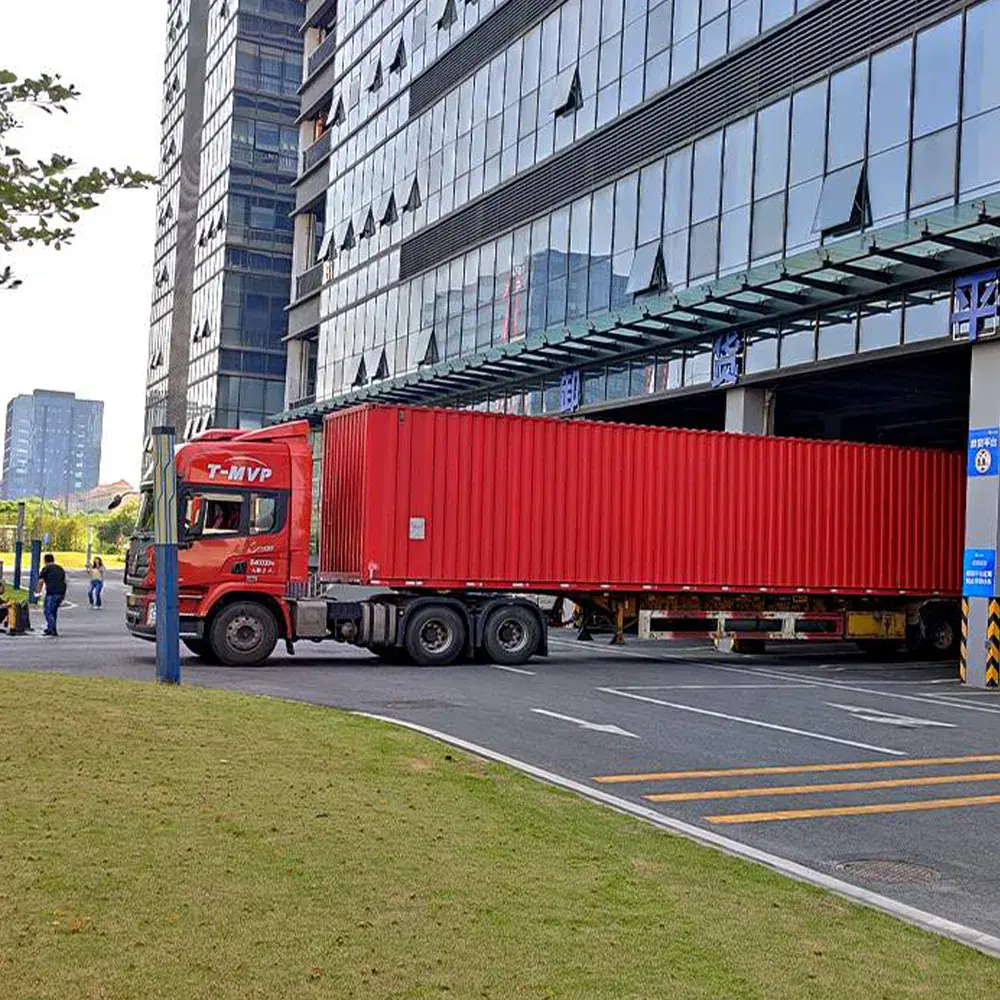
The shipping area outside the workshop was a hive of activity. After multiple rounds of full-machine commissioning, simulated mass-production validation, and factory quality inspection, a Jiuju DC motor automatic assembly line completed all factory-out procedures, was loaded onto trucks on schedule, and is about to depart for the customer's production base, helping the customer's project advance production implementation on plan.
The performance of axial-flux motors is highly dependent on their spatial topology. This article analyzes four fundamental topologies—SSSR, DSSR, DRSS, and multi-disk stacking—as well as innovations in yoke-less and segmented stator designs.
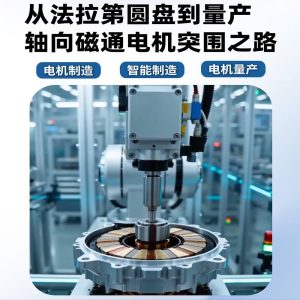
The basic principles of axial-flux motors can be traced back to Faraday's disk experiment, but manufacturing challenges prevented them from becoming mainstream in the automotive industry for a long time. This article analyzes the origins of this new manufacturing approach for an old technology.
Jiuju Automation provides high-precision automatic assembly lines for axial flux motors, covering processes such as stator winding, magnet assembly, rotor balancing, and final product testing. These lines are suitable for applications in drones, new energy vehicles, and industrial drives. The company holds over 256 patents and is ISO 9001 certified...
A fully developed automated motor assembly line can replace a large number of workers, with production capacity and consistency far exceeding those of traditional methods. This video explains the challenges of manual assembly and the key advantages of automated production lines.
 Jiuju Automation






 Spanish
 French
 German
 Hindi