The Jiuju Fan Motor Rotor Automatic Magnet Insertion Machine is specialized automated equipment custom-designed for the assembly process of magnetic steel components in fan motor rotors. The equipment integrates an intelligent control system, precision mechanical transmission structures, and high-precision vision inspection technology, enabling fully unmanned operation throughout the entire process—from automatic feeding, sorting, positioning, adhesive application, and press-fitting to inspection and unloading of the magnets. Its core operating logic relies on the coordinated interaction of multiple systems to precisely complete the entire process of embedding magnets into the slots of the rotor core, ensuring assembly accuracy, stability, and production efficiency, and meeting the demands of high-volume, standardized production.
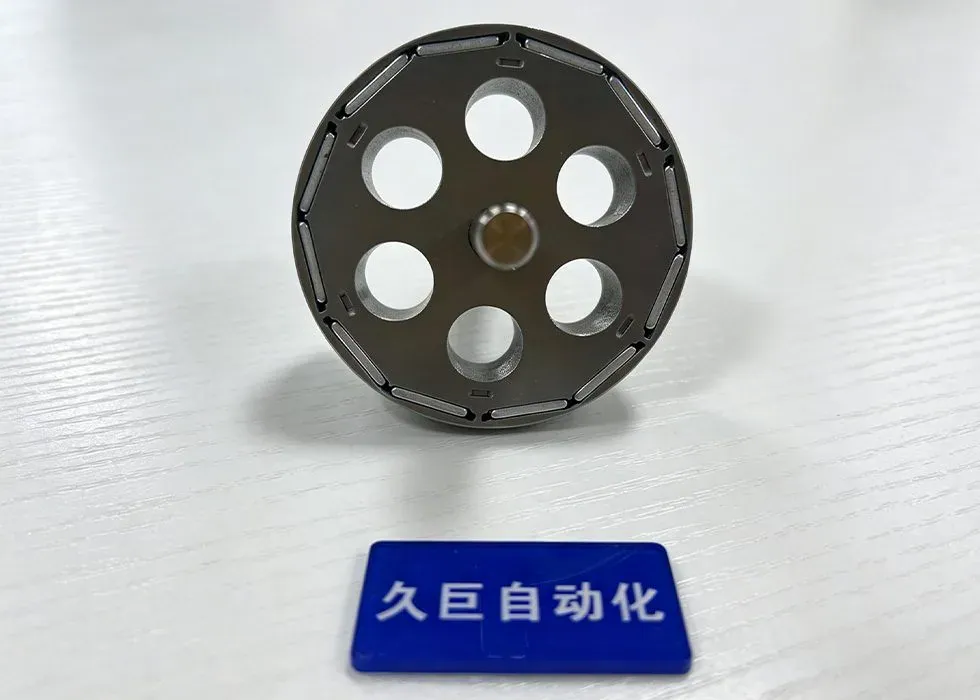
Fan Motor Rotor Product Drawing
The equipment’s overall operation process begins with the automatic feeding of magnets and intelligent polarity sorting. The magnets are automatically and systematically sorted and fed via a vibratory feeder, and a smart distribution system is used to screen them by specifications and ensure orderly conveyance. At the same time, a dedicated polarity detection module accurately identifies the direction of the magnetic poles in real time, completely eliminating the issue of reverse assembly. This prevents defects such as disruption of the motor’s magnetic circuit and performance abnormalities, and strictly ensures that the polarity of the magnets within the same batch is uniform and that assembly standards are consistent.
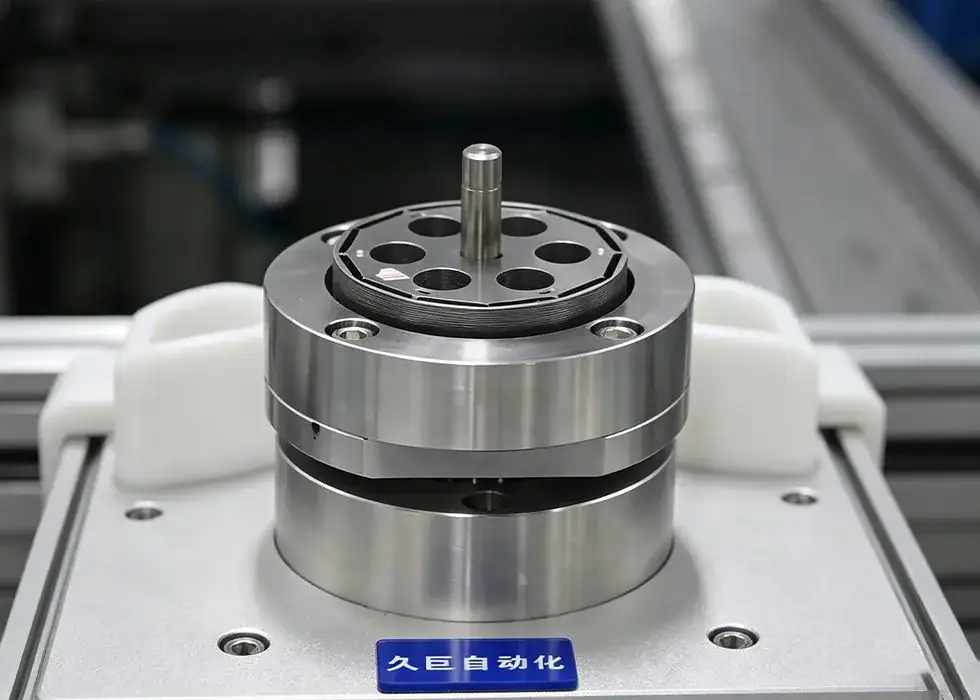
Glued Magnet Inserted Finished Product
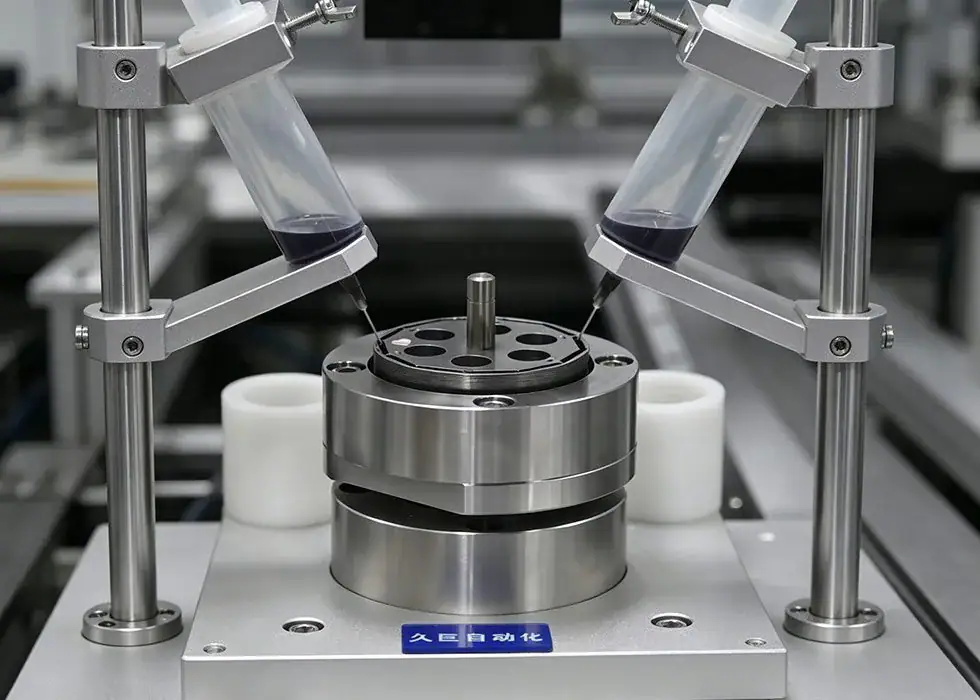
After the magnetic steel sorting is complete, the process moves on to the rotor precision positioning and automatic adhesive application stages. The equipment uses pneumatic grippers to securely clamp and precisely position the rotor. Relying on a high-definition vision recognition system, it captures and locates the rotor’s core slots in real time. In conjunction with a precision servo drive mechanism that automatically fine-tunes the rotor’s angle, this ensures high-precision alignment between the rotor slots and the magnet insertion station. At the same time, the automatic dispensing system follows the slot trajectory to apply a precise, uniform amount of adhesive at a constant speed, providing a reliable bonding foundation for the subsequent magnetic steel press-fitting process and ensuring that the magnetic steel remains securely fastened without loosening after assembly.
Motor Rotor Automatic Glue Dispensing
Precise servo-driven insertion of magnets is a critical step in the equipment’s operation. The equipment is equipped with a high-precision servo insertion system that smoothly and accurately presses the magnets into the slots of the rotor core according to preset process trajectories, speeds, and strokes. Throughout the entire press-fitting process, a built-in pressure sensor dynamically monitors the press force in real time and intelligently fine-tunes the operating speed and press-fitting parameters. This effectively prevents issues such as magnet fracture due to excessive pressure, assembly misalignment, and insufficient insertion depth, ensuring that the insertion angle, depth, and assembly tightness of every magnet are highly consistent.
Check the magnetic sheet
Finally, real-time inspection and automatic sorting and unloading of finished products are performed. After the magnet insertion process is complete, the equipment’s inspection module comprehensively verifies key indicators such as magnet assembly position, insertion depth, and bonding strength. Rotors that pass inspection are automatically unloaded and collected by the transfer mechanism; defective units with assembly flaws trigger an automatic alarm and are precisely rejected, preventing them from entering the next process. The entire process requires no manual intervention, thoroughly addressing industry pain points associated with traditional manual assembly—such as poor precision, low production efficiency, inconsistent product quality, and unstable yield rates—and comprehensively ensuring the production quality and operational stability of fan motors.
Jiuju Automation provides automated assembly solutions for drive motors in new energy vehicles, integrating key processes such as winding, magnet insertion, magnetization, and testing to ensure high efficiency, high consistency, and full traceability throughout the entire process.
Jiuju Automation integrates processes such as winding, magnet insertion, magnetization, balancing, and testing to provide complete automated motor assembly line solutions, helping customers maintain stable production and improve efficiency, backed by over 256 patents and the ISO 9001 quality management system.
Jiuju Automation provides automated assembly solutions for drive motors in new energy vehicles, integrating key processes such as winding, magnet insertion, magnetization, and testing to ensure high efficiency, high consistency, and full traceability throughout the entire process.
Jiuju Automation provides automated production lines for servo motors, enabling precise alignment of rotors and stators, integrated encoders, and EOL testing. These systems are widely used in the fields of industrial automation and robotics.
 Jiuju Automation




 Spanish
 French
 German
 Hindi