Motor Magnet Insertion Equipment: What Are the Standards for Testing Magnetic Field Uniformity After Magnet Insertion? — Jiuju Motor Automatic Assembly Line
Q: Why is it necessary to measure magnetic field uniformity after inserting the magnet?
The uniformity of the magnetic field after the motor is magnetized affects the no-load current; this paper presents testing standards and criteria for determining whether repairs are necessary.
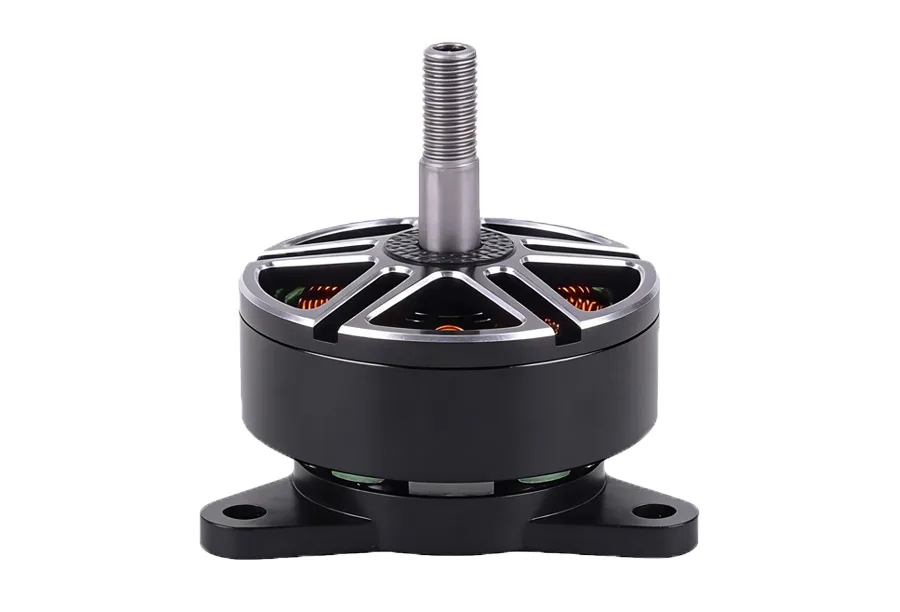
Magnets that are misaligned, installed backwards, or iron filings left behind can all cause an uneven rotor magnetic field. Last year, we provided on-site support to a client manufacturing motors for drones. After magnetizing a batch of rotors, the no-load current fluctuation reached 18%. Upon scanning each rotor individually with a gauss meter, we discovered that three magnets had their polarities reversed. After the repair, the current fluctuation dropped to within 51 TP3T. A non-uniform magnetic field causes cogging torque ripple during motor operation, resulting in significantly increased noise at high speeds.
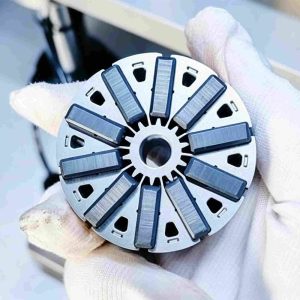
Glued Magnet Inserted Finished Product
Q: What is the most reliable instrument to use for on-site testing?
Benchtop Gauss meters or rotating scanning stands are commonly used on production lines. Taking a typical φ30mm outer-rotor motor as an example, the scan should include at least 8 evenly spaced points, and the deviation of the magnetic flux density at any single point from the average value must be within ±5% to be considered acceptable. For more stringent applications, such as motors used in drones or automotive electronics, it is recommended to tighten the deviation limit to ±31 TP3T and to record the polar angle of each magnet.
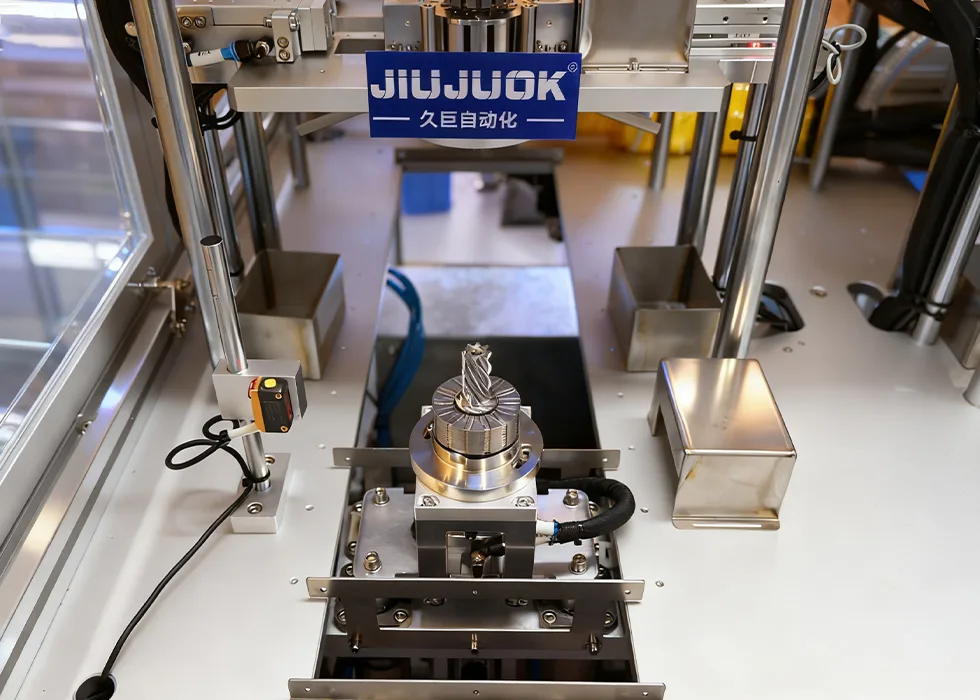
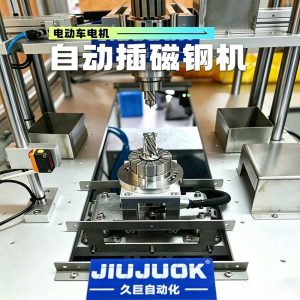
Jiuju Electric Vehicle Magnet Inserting Machine
Q: What should I do if the test results are unsatisfactory?
First, identify the magnet part numbers with deviations exceeding the tolerance limits to determine whether the issue stems from the incoming magnet material or the insertion depth. If the insertion depth deviation is within 0.2 mm, it can be fine-tuned by applying additional pressure; if the deviation exceeds 0.3 mm or the polarity is reversed, the magnet must be removed and reinserted. Demagnetization checks must be performed on removed magnets; those with surface residual magnetism exceeding 10% should be scrapped immediately to prevent performance drift after being put back into service.
Jiuju Automation provides automated assembly solutions for drive motors in new energy vehicles, integrating key processes such as winding, magnet insertion, magnetization, and testing to ensure high efficiency, high consistency, and full traceability throughout the entire process.
Jiuju Automation provides automated production lines for servo motors, enabling precise alignment of rotors and stators, integrated encoders, and EOL testing. These systems are widely used in the fields of industrial automation and robotics.
Jiuju Automation has designed a magnet insertion machine for the assembly of integrated permanent magnet (IPM) rotors and surface-mount magnets, ensuring precise pole spacing and high production efficiency.
Jiuju Automation provides automated assembly solutions for drive motors in new energy vehicles, integrating key processes such as winding, magnet insertion, magnetization, and testing to ensure high efficiency, high consistency, and full traceability throughout the entire process.
 Jiuju Automation




 Spanish
 French
 German
 Hindi