Long changeover times in mixed-line production of magnet assemblies are a major challenge for the magnet insertion workshop; modular fixtures and parameter memory can significantly reduce these times.
Q: Where does the biggest waste of time occur in mixed-line production?
It’s not about changing the fixture itself, but rather finding the right program, adjusting parameters, and running test runs. We analyzed the data from a client’s magnetic insert workshop in Dongguan and found that the average downtime for changeovers was 47 minutes, of which fixture replacement accounted for only 8 minutes; the remaining 39 minutes were spent adjusting insertion depth, positioning speed, and the orientation of the magnetic inserts. The reason for this was that the program names stored on each machine were disorganized, and operators entered them based on experience.
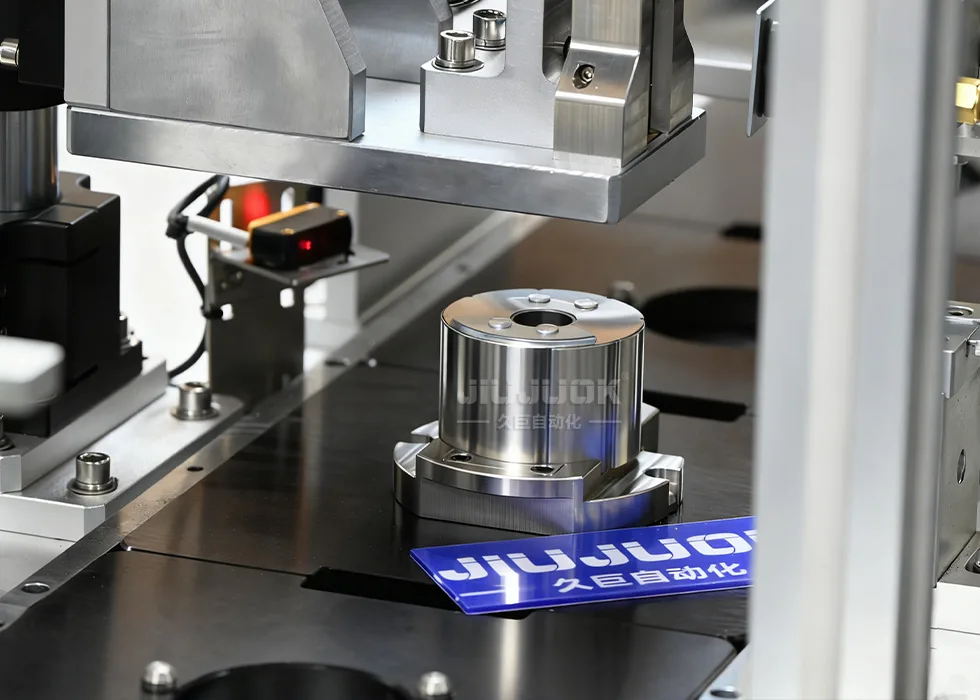
Finished Inserted Magnet Products
Q: What are the key steps to implementing quick changeovers?
Step 1: Design the fixture with a quick-change mechanism using pneumatic locking or positioning pins, with the goal of reducing fixture changeover time to less than 3 minutes; Step 2: Create a product recipe library in the PLC, saving settings for magnet length, insertion depth, and insertion speed under model-specific names so they can be automatically loaded upon retrieval; Step 3: Set up mandatory first-piece verification; automatic operation is only enabled after 10 consecutive pieces pass inspection. After implementing SMED, this client’s changeover time was reduced from 47 minutes to 15 minutes.
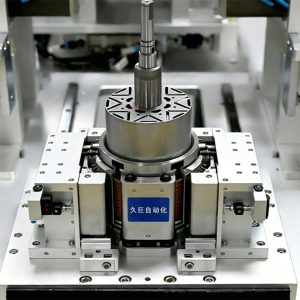
Water Pump Motor Rotor Equipment
Q: How can errors be prevented on mixed-product production lines?
Install a vision inspection system at the hopper inlet to verify that the dimensions of the magnets match the current formula; add a photoelectric sensor before the insertion station to confirm the polarity of the magnets. We once encountered a batch where N42 and N48 magnets were mixed; visual sorting intercepted 12 incorrectly sorted pieces. Additionally, we recommend scheduling similar models at separate times and avoiding consecutive changeovers for magnets with minor differences in color or height, to allow operators sufficient time for verification.
In response to the needs of the low-altitude economy and the power requirements of drones, Jiuju Automation has launched an automated production line for drone motors, improving thrust-to-weight ratio and consistency, and helping drone OEMs reduce costs through mass production.
Jiuju Automation provides automated production lines for servo motors, enabling precise alignment of rotors and stators, integrated encoders, and EOL testing. These systems are widely used in the fields of industrial automation and robotics.
Jiuju Automation provides automated production lines for servo motors, enabling precise alignment of rotors and stators, integrated encoders, and EOL testing. These systems are widely used in the fields of industrial automation and robotics.
Jiuju Automation provides automated equipment for motor manufacturing and complete assembly line solutions, with over 256 patents, an ISO 9001 quality management system, and comprehensive global service support.
 Jiuju Automation






 Spanish
 French
 German
 Hindi