Failure to meet the inter-turn voltage withstand test is a common defect after winding; inspecting the enameled wire, tension, and mold can quickly pinpoint the root cause.
Q: What does an abnormal waveform in a turn-to-turn withstand voltage test typically indicate?
If the waveform shows significant attenuation or oscillation, it indicates an interturn short circuit or a weak point in the insulation within the winding. There are three common root causes: pinholes or varnish bumps on the enameled wire itself; excessive winding tension that scratches the varnish coating; or sharp edges on the mold that tear the wire insulation. On one of our production lines, the defect rate for a batch of products with a 0.18 mm wire diameter suddenly rose to 3.51 TP3T. Upon investigation, we determined that wear on the tension pulley had caused tension fluctuations exceeding ±151 TP3T.
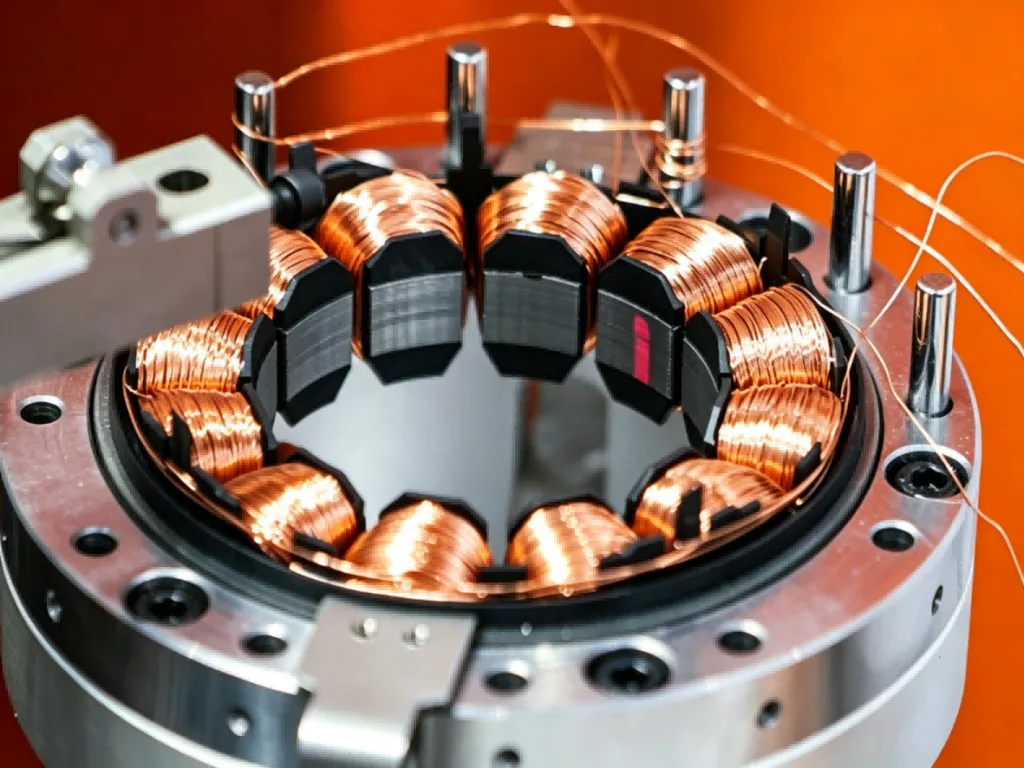
Precision Winding
Q: When troubleshooting, should you check the cables first or the equipment?
First, inspect the incoming wire. Conduct a pinhole test and a varnish film continuity test on the same reel of enameled wire in the laboratory. If the number of pinholes exceeds 3 per 5 meters, prioritize replacing the material. Once the wire has been approved, inspect the equipment: check whether the tensioner setting exceeds 30% of the enameled wire’s breaking strength; check for burrs on the feed rollers and guide pins; and ensure the wire feed path is smooth. Regarding the molds, it is recommended that the chamfer on the grooves be at least R0.3.
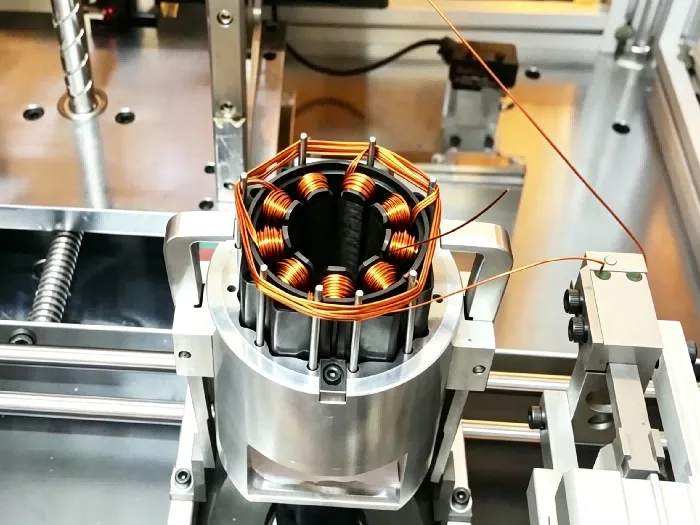
Winding Equipment
Q: How should test parameters be set to minimize false positives?
The pulse voltage is set to 2–3 times the motor’s rated voltage, with the rising edge controlled to within 1 μs; this makes the waveform more sensitive to minor short circuits. At the same time, a standard waveform template must be established by using the waveform from the first accepted unit as a reference, against which each subsequent unit is automatically compared for similarity. We generally set the similarity threshold at 85%; values below 80% are immediately judged as NG, while those between 80% and 85% are manually reviewed to avoid misjudging minor variations in normal windings as defects.
Jiuju Automation provides CNC motor winding machines and stator winding production lines suitable for brushless, servo, series-wound, and transformer coils, ensuring full slot fill and consistent turn-to-turn consistency.
Jiuju Automation provides CNC motor winding machines and stator winding production lines suitable for brushless, servo, series-wound, and transformer coils, ensuring full slot fill and consistent turn-to-turn consistency.
Jiuju Automation provides CNC motor winding machines and stator winding production lines suitable for brushless, servo, series-wound, and transformer coils, ensuring full slot fill and consistent turn-to-turn consistency.
Jiuju Automation provides CNC motor winding machines and stator winding production lines suitable for brushless, servo, series-wound, and transformer coils, ensuring full slot fill and consistent turn-to-turn consistency.
 Jiuju Automation






 Spanish
 French
 German
 Hindi