Winding is one of the most critical processes in motor manufacturing. As motors have evolved, different “schools” of winding techniques have emerged. The winding process is one of the most important steps and is key to enhancing overall equipment performance and increasing productivity.
I. Classification Based on the Magnetic Poles Formed by the Stator Windings
Stator windings can be classified into two types—salient-pole and non-salient-pole—based on the relationship between the number of magnetic poles in the motor and the number of actual magnetic poles formed by the winding configuration.
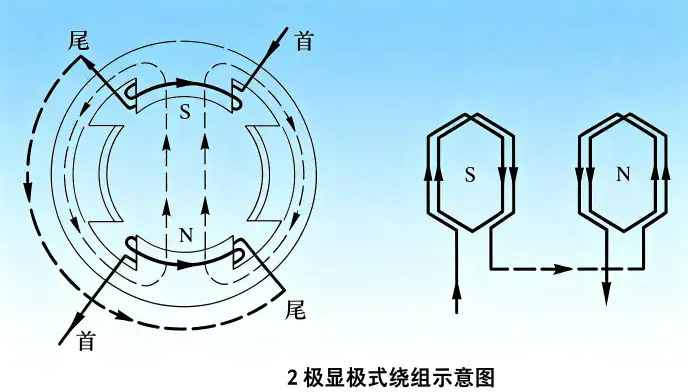
1. Exposed-pole winding
In a pole-type winding, each set of coils forms a magnetic pole, and the number of coils in the winding is equal to the number of magnetic poles.
In a salient-pole winding, to ensure that the N and S poles are alternated, the current directions in two adjacent coils must be opposite; that is, the two adjacent coils must be connected end-to-end, and the leads of the two coils must be connected end-to-end (known in electrical engineering as “tail-to-tail, head-to-head”), which is also known as the reverse series connection.
Concentrated Winding
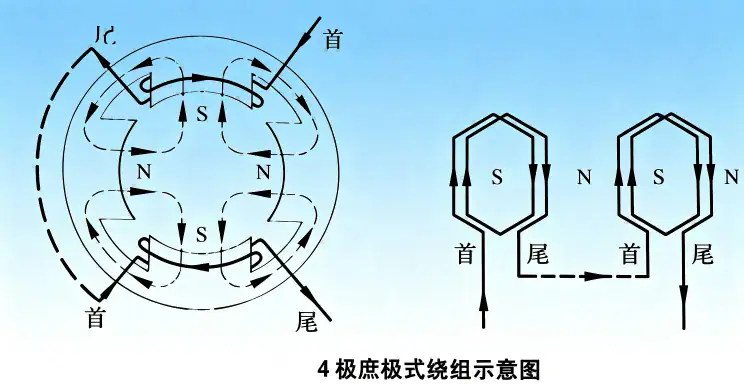
2. Shu Ji-style winding
In a semi-polar winding, each coil forms two magnetic poles, and the number of coils in the winding is half the number of magnetic poles, because the other half of the magnetic poles are formed jointly by the magnetic flux lines generated by the coils.
In a common-pole winding, the magnetic poles formed by each coil have the same polarity; therefore, the direction of the current in all coils is the same. This means that adjacent coils should be connected end-to-end (known in electrical engineering as a “tail-to-head” connection), i.e., in a series connection.
Consequent Pole Winding
II. Classification Based on the Shape of the Stator Windings and the Mounting and Wiring Methods
Stator windings can be classified into two types—centralized and distributed—based on the shape of the coil windings and the method of installation and wiring.
1. Concentrated Winding
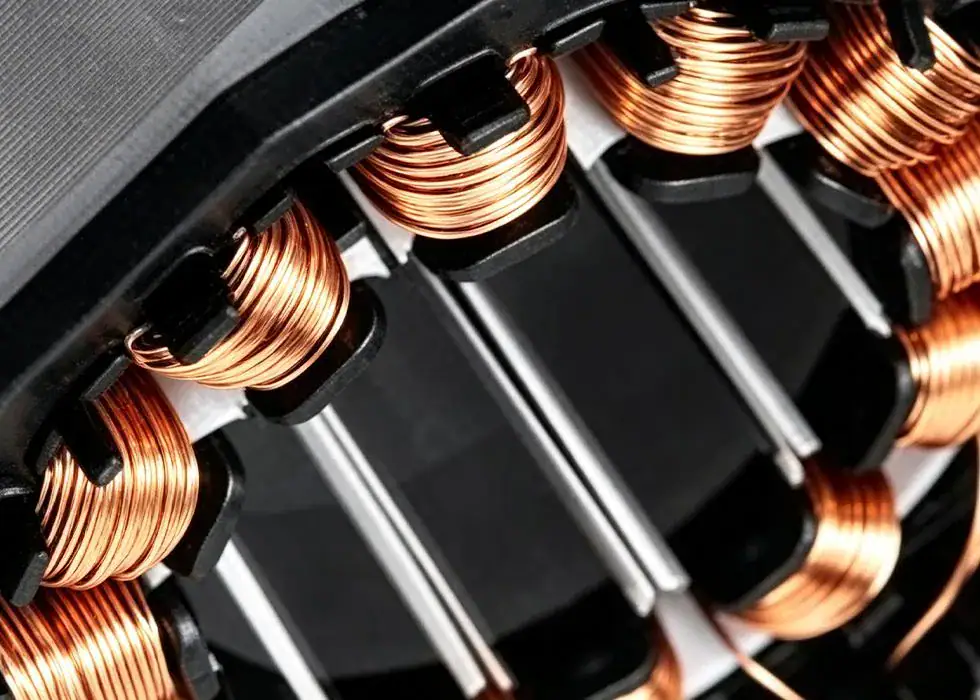
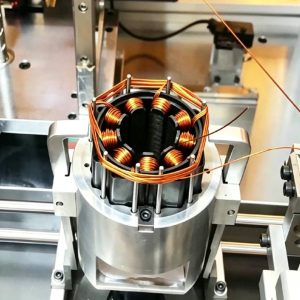
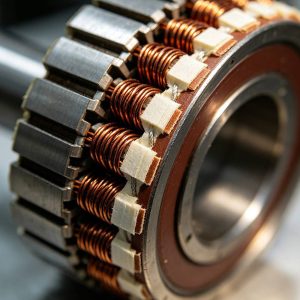
Concentrated windings generally consist of only one or a few rectangular frame coils. After winding, they are wrapped with yarn tape to set their shape, then impregnated with varnish and dried before being mounted on the iron core of the salient-pole motor. This type of winding is used in the field coils of DC motors and general-purpose motors, as well as in the main pole windings of single-phase shaded-pole motors.
Concentrated Winding
2. Distributed Winding
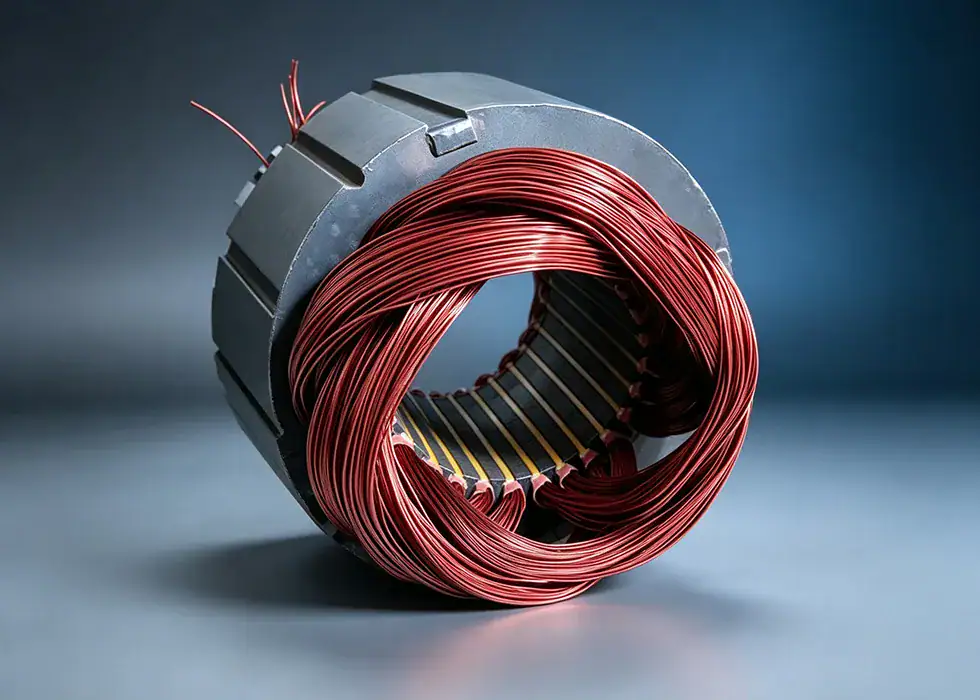
In motors with distributed windings, the stator does not have protruding pole shoes; instead, each magnetic pole consists of a coil group formed by one or more coils arranged and wired according to a specific pattern. Depending on the arrangement of the coils, distributed windings can be classified into two types: concentric and stacked.
Concentric Winding
(1) Concentric Winding
A concentric winding consists of several rectangular coils of different sizes within the same coil group, arranged one after another around a common center to form a loop-shaped configuration. Concentric windings are further classified into single-layer and multi-layer types. This configuration is typically used for the stator windings of single-phase motors and some low-power three-phase induction motors.
(2) Stacked Winding
In a stacked winding, all coils are identical in shape and size (with the exception of single- and double-turn coils); one side of each coil is embedded in each slot, and the coils are evenly distributed by stacking them one on top of the other at the outer ends of the slots. Stacked windings are further classified into single-layer and double-layer types.
A single-layer stacked winding, or single-stacked winding, consists of only one coil leg embedded in each slot; a double-layer stacked winding, or double-stacked winding, consists of two coil legs from different coil groups embedded in each slot (arranged in upper and lower layers).
Depending on variations in the wiring configuration, stacked windings can be further classified into single- and double-turn interlaced wiring arrangements and single- and double-layer mixed wiring arrangements;
In addition, windings with a specific configuration at the ends—known as chain-type windings or basket-type windings—are, in fact, both types of laminated windings. Laminated windings are commonly used for the stator windings of three-phase induction motors.
Jiuju Automation provides CNC motor winding machines and stator winding production lines suitable for brushless, servo, series-wound, and transformer coils, ensuring full slot fill and consistent turn-to-turn consistency.
Jiuju Automation provides CNC motor winding machines and stator winding production lines suitable for brushless, servo, series-wound, and transformer coils, ensuring slot fill rate and turn-to-turn consistency. This article analyzes the technical principles, application scenarios, and key selection criteria related to this topic, providing...
Jiuju Automation provides CNC motor winding machines and stator winding production lines suitable for brushless, servo, series-wound, and transformer coils, ensuring full slot fill and consistent turn-to-turn consistency.
 Jiuju Automation




 Spanish
 French
 German
 Hindi