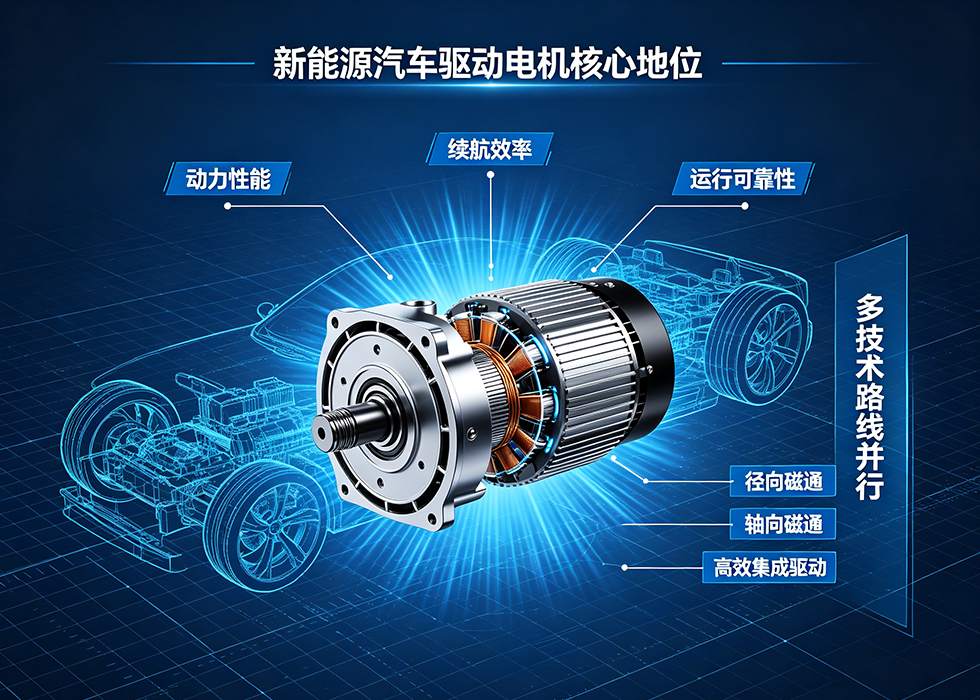
The drive motor of a new-energy vehicle is the core component of the powertrain, responsible for converting between electrical and mechanical energy and directly determining the vehicle's power performance, range efficiency and operating reliability. The industry currently presents a pattern of multiple technical routes running in parallel, with different motor types differing markedly in structural principle, performance characteristics and applicable scenarios; the maturity of manufacturing processes is the key support for each route moving from technical validation to large-scale production.
Core Role of the Drive Motor in New Energy Vehicles
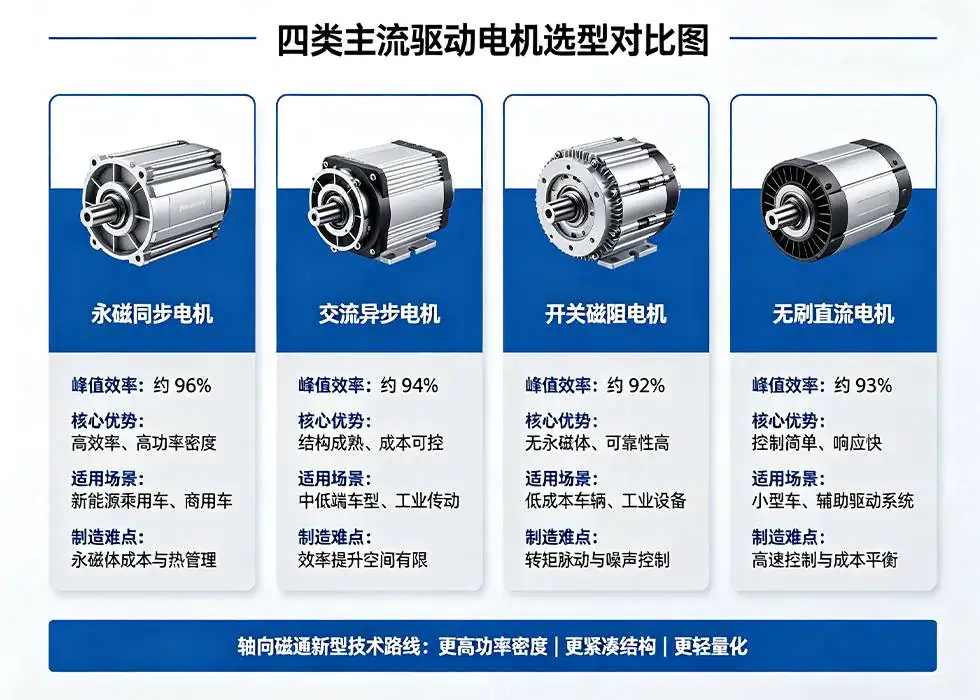
Mainstream drive motors on the market fall into four major categories: permanent-magnet synchronous motors, with peak efficiency of 97%-98%, high power density and low noise, occupy over 90% of the new-energy passenger-car market, but require high precision in magnet magnetizing and stator winding and carry demagnetization risk at high temperature; AC induction motors are simple in structure and strong in overload capacity with no demagnetization issue, and are mostly used in high-performance models and commercial vehicles, with manufacturing difficulties concentrated in squirrel-cage rotor forming and dynamic-balance control; switched-reluctance motors are low-cost and resistant to harsh conditions, suiting electric buses and special-purpose vehicles, but require overcoming the machining difficulty of salient-pole structures; and brushless DC motors are simple to control and mainly used in small vehicles and auxiliary systems. In addition, new technical routes such as axial-flux motors are also accelerating their evolution.
Four Mainstream Drive Motors Comparison Chart
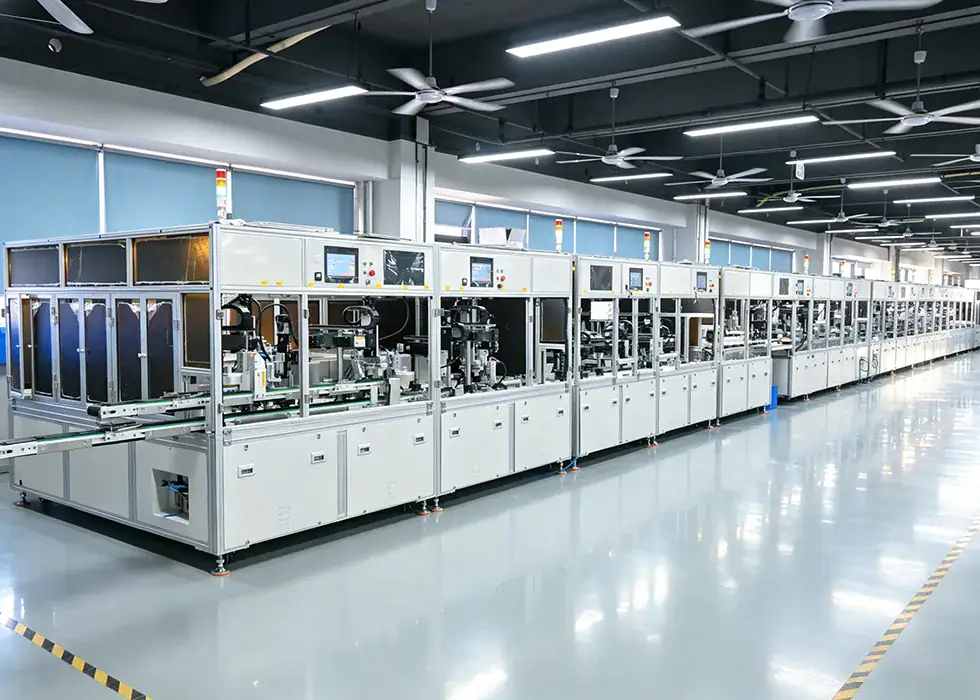
Jiuju has long cultivated motor automation manufacturing and magnetizing processes and can cover the core manufacturing operations of many types of drive motors. For permanent-magnet synchronous motors it offers overall stator-rotor magnetizing and precision joining solutions that guarantee magnet saturation and air-gap precision for consistent motor performance; for induction and switched-reluctance motors it supplies line solutions including automated stator winding and precision rotor press-fitting to raise mass-production efficiency and yield; and for new motor types such as axial-flux motors it has accumulated process experience in precision assembly under strong magnetic attraction, supporting the mass-production rollout of new technology routes.
Jiuju Automatic Motor Assembly Line
As the new-energy vehicle market keeps expanding, coordinated development of multiple technical routes will become the industry norm. With full-process accumulation and full-line automation capability, Jiuju can flexibly match the mass-production needs of motors on different routes, helping the industry raise its manufacturing level and driving high-quality development of the drive-motor industry.
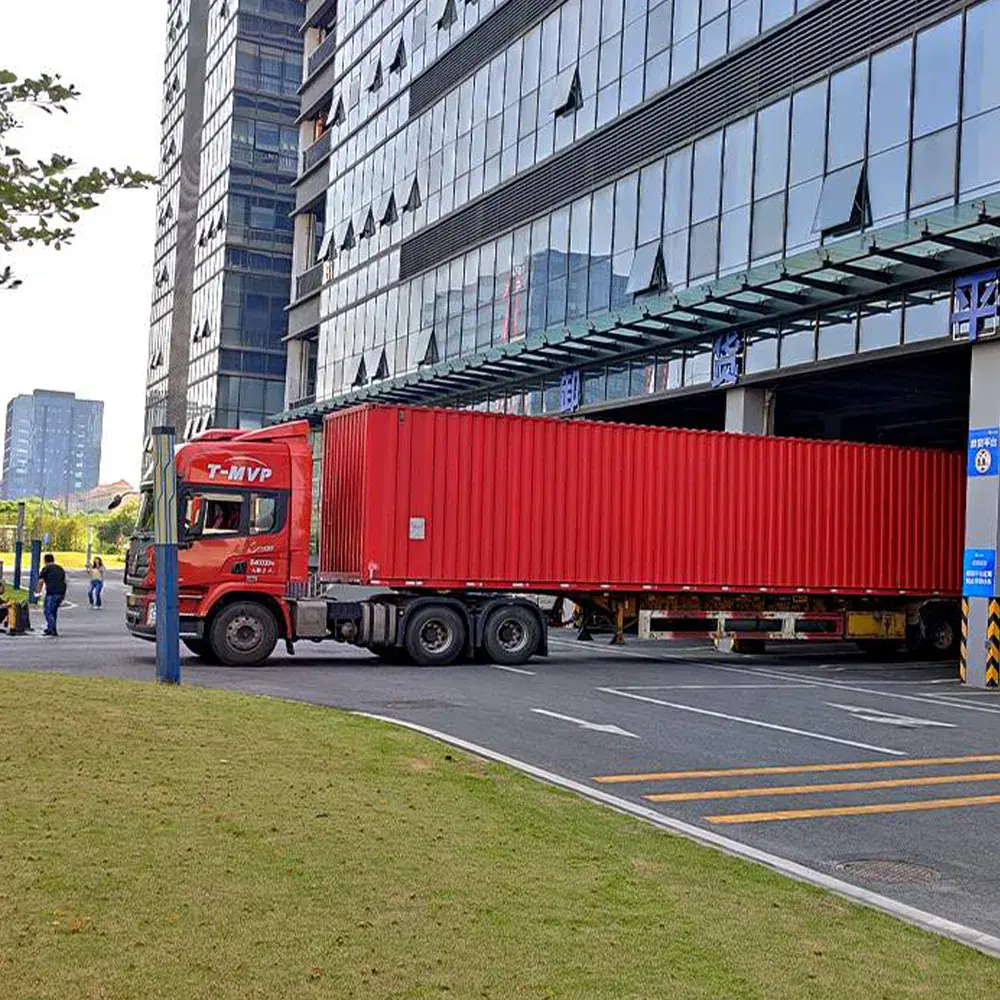
The shipping area outside the workshop was a hive of activity. After multiple rounds of full-machine commissioning, simulated mass-production validation, and factory quality inspection, a Jiuju DC motor automatic assembly line completed all factory-out procedures, was loaded onto trucks on schedule, and is about to depart for the customer's production base, helping the customer's project advance production implementation on plan.
A multi-pole architecture brings a high-frequency fundamental; at 10,000 rpm the fundamental frequency can reach several kHz. Traditional IGBTs suffer soaring switching losses and severe heating — it is the MHz-class switching capability of SiC MOSFETs that truly matches high-frequency multi-pole axial flux motors.
Jiuju Automation provides high-precision automatic assembly lines for axial flux motors, covering processes such as stator winding, magnet assembly, rotor balancing, and final product testing. These lines are suitable for applications in drones, new energy vehicles, and industrial drives. The company holds over 256 patents and is ISO 9001 certified...
A multi-pole architecture brings a high-frequency fundamental; at 10,000 rpm the fundamental frequency can reach several kHz. Traditional IGBTs suffer soaring switching losses and severe heating — it is the MHz-class switching capability of SiC MOSFETs that truly matches high-frequency multi-pole axial flux motors.
A multi-pole architecture brings a high-frequency fundamental; at 10,000 rpm the fundamental frequency can reach several kHz. Traditional IGBTs suffer soaring switching losses and severe heating — it is the MHz-class switching capability of SiC MOSFETs that truly matches high-frequency multi-pole axial flux motors.
 Jiuju Automation





 Spanish
 French
 German
 Hindi