 Jiuju Automation



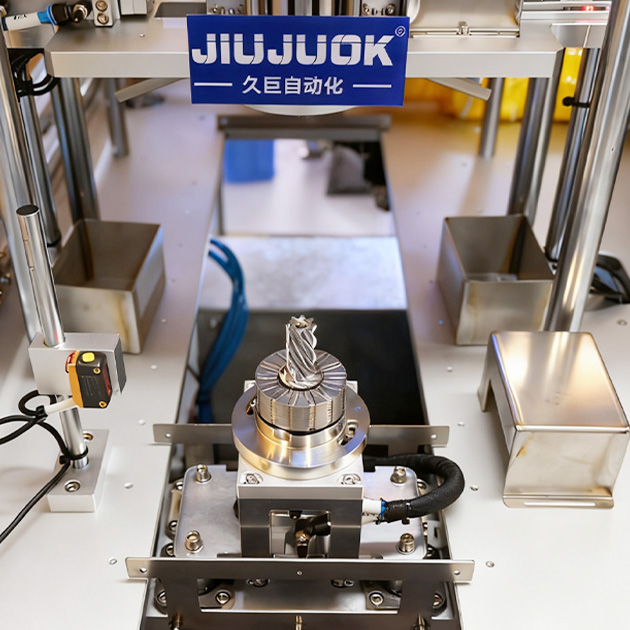
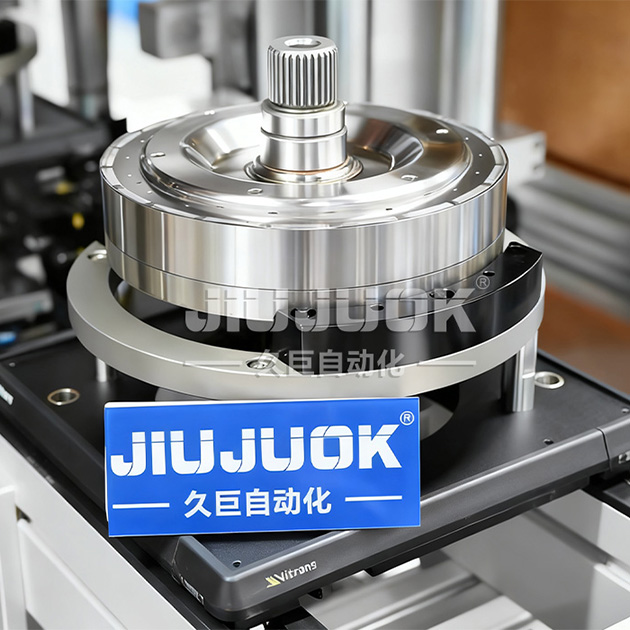
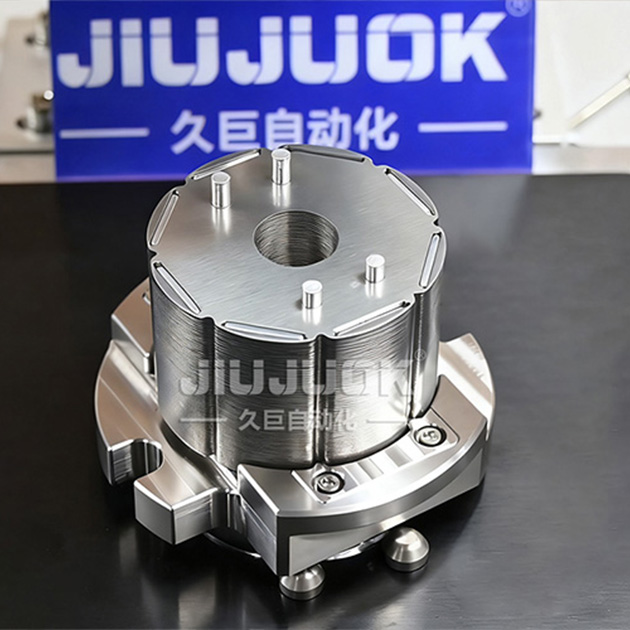
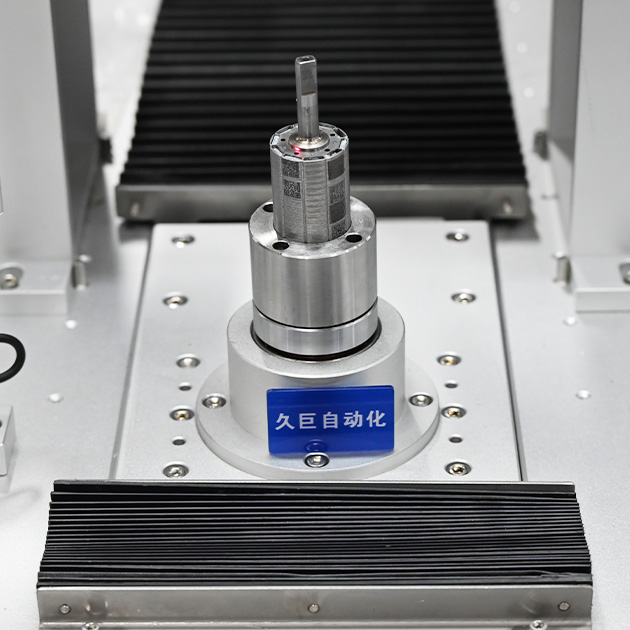
Detailed parameters of the inner rotor automatic dispensing and insertion magnet steel machine
- Product Name:Inner-Rotor Automatic Glue-Dispensing & Magnet Insertion Machine
- Process:Manual loading-Automatic dispensing-Automatic feeding-Machine module inserting magnet-Automatic return-Manual discharging
- Dispensing accuracy:95%
- Changeover time:designable
- Equipment beats:>800pcs/H
- Operator:1 person
- Discharge method:Multi-track automatic discharge
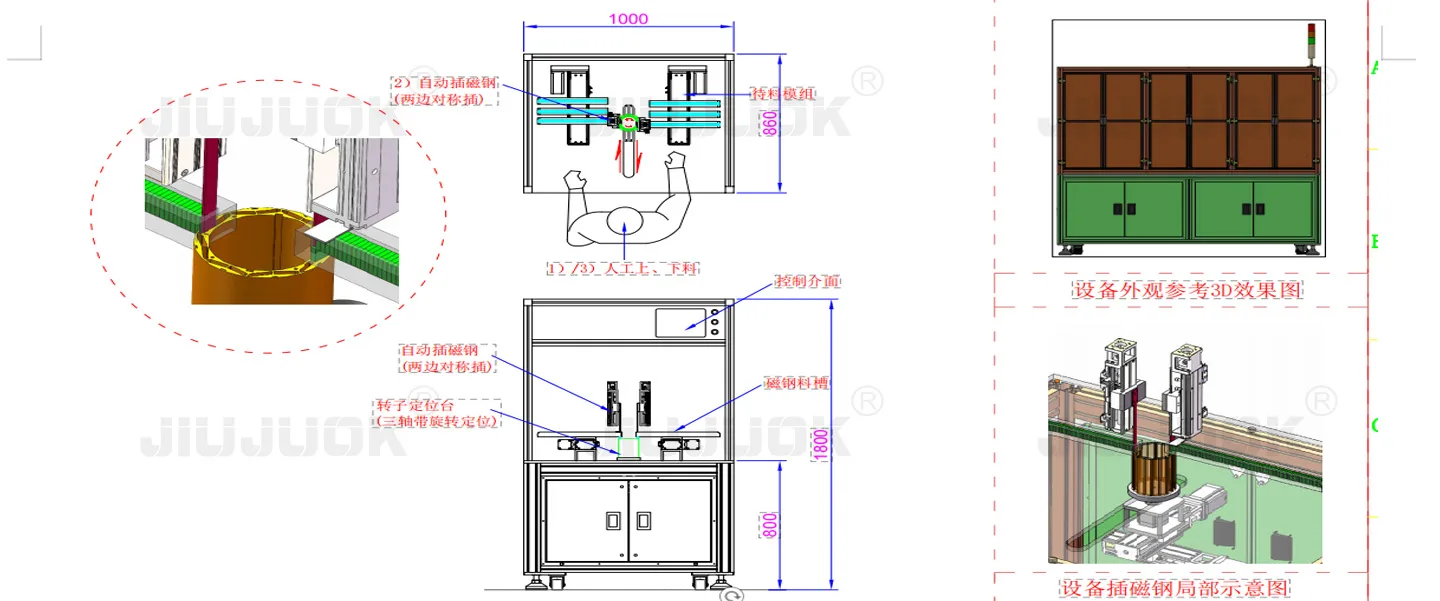
ProductOverview:
Automaticglue dispensingand magnet insertion:Automatic dispensing and insertion of magnets for products. The process is as follows: manual loading→automatic dispensing→automatic feeding→magnetic steel insertion by mechanical module→automatic return→manual discharging. In the design of the design of safety devices, personnel body in the equipment, equipment in the state of shutdown, to protect the safety of personnel. The anti-dulling mechanism at the loading station avoids the increase of NG rate caused by loading materials. Before the magnet is inserted, the magnet in position pressurizing mechanism is designed to further ensure that the magnet is installed in place.
Program Description:
Automatic glue dispensing andmagnet bonding, steel-sleeve pressing integrated machine. 1, AB adhesive is mixed at a 1:1 ratio with a viscosity of 10000 mPa.s and applied with a dual-liquid thimble-type dispensing gun; dispensing can be carried out in the up or down direction as required. 2, manual loading of therotor, which is then placed at the dispensing station for dispensing, with rotation and up-and-down dispensing. 3, after dispensing, the operator carries the product to the steel-sleeve pressing station; the product then moves automatically to the magnet bonding station, where magnets are bonded in opposing pairs. After one pair is bonded, the product rotates by a set angle to bond the next opposing pair; for multi-layer stepped or skewed designs the rotation angle is set in the program, and for repelling magnets a suitable gap and height can be set in the program before the steel sleeve is pressed to align the position. 4, once the magnets are bonded, the product moves automatically to the steel-sleeve pressing station; sleeves are loaded onto the fixture by hand one at a time, and after each sleeve is pressed the operator loads the next one. If the product takes two layers of sleeves, the operator turns the product over and presses the second sleeve; both ends are aligned after pressing. 5, after the sleeves are pressed, the product is unloaded manually.
Motor automation equipment recommendation
Recommendation
Unfortunately, no information was found for you
Frequently Asked Questions
Common questions on selection, process and delivery. To learn more, contact us directly.
Q1. Can this machine insert magnets on multi-layer, segmented skewed rotors?
Yes. After bonding one pair of magnets the rotor rotates to a programmed angle for the next pair, and the layer angles are controlled by the program without mechanical changes. The prerequisite is that layer count and angles are clearly programmable in your drawing.
More motor equipment FAQsQ2. How are shallow insertion and tilted magnets prevented?
A boost mechanism confirms the magnet has reached its locating face before pressing, and a poka-yoke at the loading station stops wrongly oriented parts from entering the next step. Both address insertion defects directly.
More motor equipment FAQsQ3. How do the machine and operator work together, and how is safety handled?
The operator loads and unloads; dispensing, feeding, insertion and retraction are automatic. When an operator is inside the machine envelope the equipment is stopped, so moving parts cannot be triggered.
More motor equipment FAQsQ4. How are the dispensing valve and adhesive matched?
The process is built around two-component AB adhesive at a 1:1 ratio, for adhesive around 10000 mPa·s, dispensed through a two-component needle valve that can work upward or downward as required. Changing adhesive type means re-calibrating the valve and dispensing parameters.
More motor equipment FAQsQ5. Can one person run it, and what should the operator watch at loading?
One operator is enough. After manual loading the machine handles dispensing, feeding, insertion and retraction; the loading station has a poka-yoke so a wrongly oriented part cannot enter the next step. New operators mainly learn the loading orientation rather than the whole process.
More motor equipment FAQsOnline Message
Online Message
 Español
 Français
 Deutsch (Sie)
 हिन्दी