To understand an axial flux motor, you first need to clarify its two core components: the stator, which is stationary and wound with coils, and the rotor, which carries magnets and rotates to output power. The direction of the magnetic field directly determines the motor's form and performance.
Axial Flux Comparison
The magnetic field of a conventional radial-flux motor radiates outward from the centre, giving an overall cylindrical drum shape. In an axial-flux motor the field travels along the shaft direction, with rotor and stator stacked layer upon layer like a sandwich. Thanks to a leverage effect similar to a long wrench, the magnetic force acts farther from the axis, giving it far higher power density than a conventional motor. At the same power, an axial-flux motor can be half the volume and weight and save half the metal, making it especially advantageous in lightweight-demanding scenarios and suitable for new-energy commercial vehicles, two-wheelers, construction machinery, electric ships, humanoid robots, low-altitude aircraft and many other fields.
Three Major Bottlenecks in Axial Flux Motor Mass Production
This theory, born long ago, has been slow to reach large-scale deployment, with bottlenecks concentrated in materials, structure and process. High-temperature demagnetization of magnets, a strict air gap of only 0.3 mm, and the lack of suitable mass-production equipment all hold it back from leaving the laboratory. To maintain a micron-level air gap, the assembly stage must fight enormous axial magnetic attraction, and the slightest deviation causes vibration, disc rubbing or even seizure, imposing extremely high requirements on magnet layout and stator-rotor joining precision. Jiuju also continues to take part in process research in this field, carrying out equipment technology development around key operations such as magnet assembly, magnetizing and air-gap inspection, helping the industry overcome the manufacturing difficulties of mass-producing axial-flux motors.
Reshaping Future Power Scenarios
Today China has already built large-scale axial-flux motor production lines, from self-developed magnets to fully automated production, gradually achieving self-reliance and control over key links. After two hundred years, this long-shelved technology has finally reached the tipping point of industrialization. Lighter, smaller and stronger axial-flux motors are reshaping numerous power scenarios. In the future, from new-energy heavy trucks to humanoid robots, more and more disc-type motors will enter reality and change the underlying logic of the power industry.
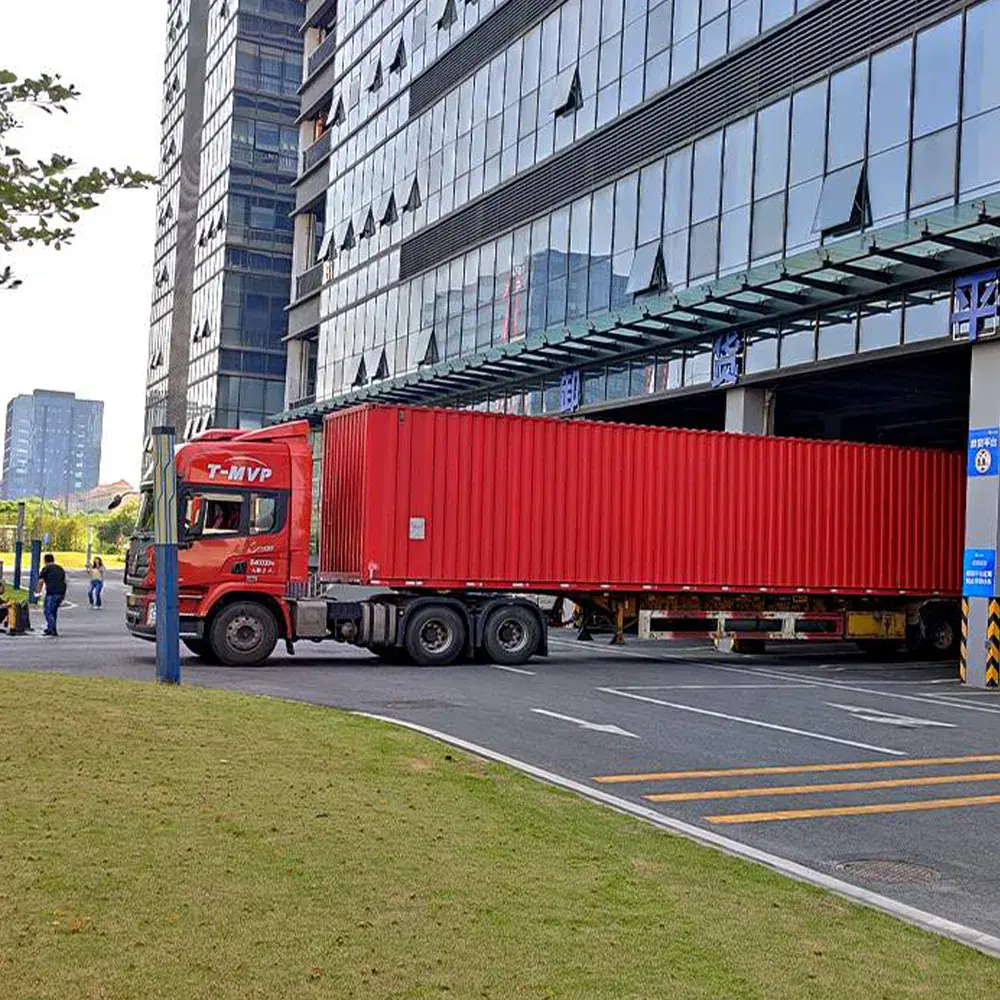
The shipping area outside the workshop was a hive of activity. After multiple rounds of full-machine commissioning, simulated mass-production validation, and factory quality inspection, a Jiuju DC motor automatic assembly line completed all factory-out procedures, was loaded onto trucks on schedule, and is about to depart for the customer's production base, helping the customer's project advance production implementation on plan.
A fully developed automated motor assembly line can replace a large number of workers, with production capacity and consistency far exceeding those of traditional methods. This video explains the challenges of manual assembly and the key advantages of automated production lines.
A multi-pole architecture brings a high-frequency fundamental; at 10,000 rpm the fundamental frequency can reach several kHz. Traditional IGBTs suffer soaring switching losses and severe heating — it is the MHz-class switching capability of SiC MOSFETs that truly matches high-frequency multi-pole axial flux motors.
While new energy vehicles and robots are stealing the spotlight, industrial applications such as elevator traction machines, fans, and water pumps are quietly adopting axial flux motors. Here, the focus isn’t on flashy specifications, but on electricity bills and reliability at scale.
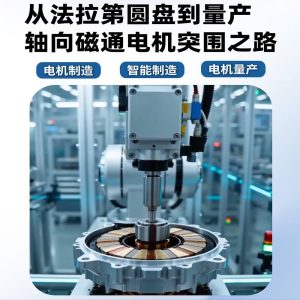
The basic principles of axial-flux motors can be traced back to Faraday's disk experiment, but manufacturing challenges prevented them from becoming mainstream in the automotive industry for a long time. This article analyzes the origins of this new manufacturing approach for an old technology.
 Jiuju Automation






 Spanish
 French
 German
 Hindi