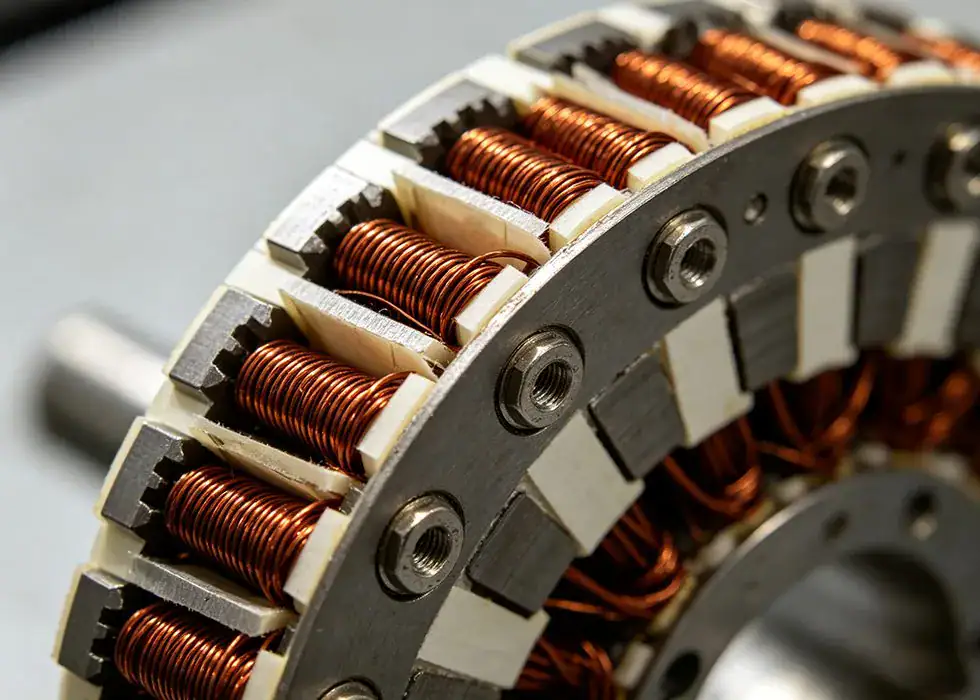
When many people look at an axial-flux motor, they first focus on the magnets and the rotor, but what really blocks mass production is the stator. The stator of a radial motor simply requires punching electrical steel axially, laminating it and cutting slots — a mature decades-old process with stable quality and controllable cost. In an axial-flux motor the stator teeth are arranged radially on a flat disc, and the flux must pass axially through, so the old approach simply does not work. Some have tried winding oriented silicon steel strip into a ring and then milling slots, but as soon as the slots are cut the grain orientation is destroyed and cutting-stress losses are introduced, greatly degrading magnetic performance.
Motor Detail Drawing
So the industry has pinned its hopes on soft magnetic composites. SMC compacted by powder metallurgy has an isotropic magnetic response that exactly suits flat magnetic circuits and sidesteps the orientation problem, but its permeability and mechanical strength have not yet caught up with high-grade electrical steel — a gap that always remains. Shaping with SMC also requires re-developing moulds and compaction processes, and costs cannot be brought down in the short term.
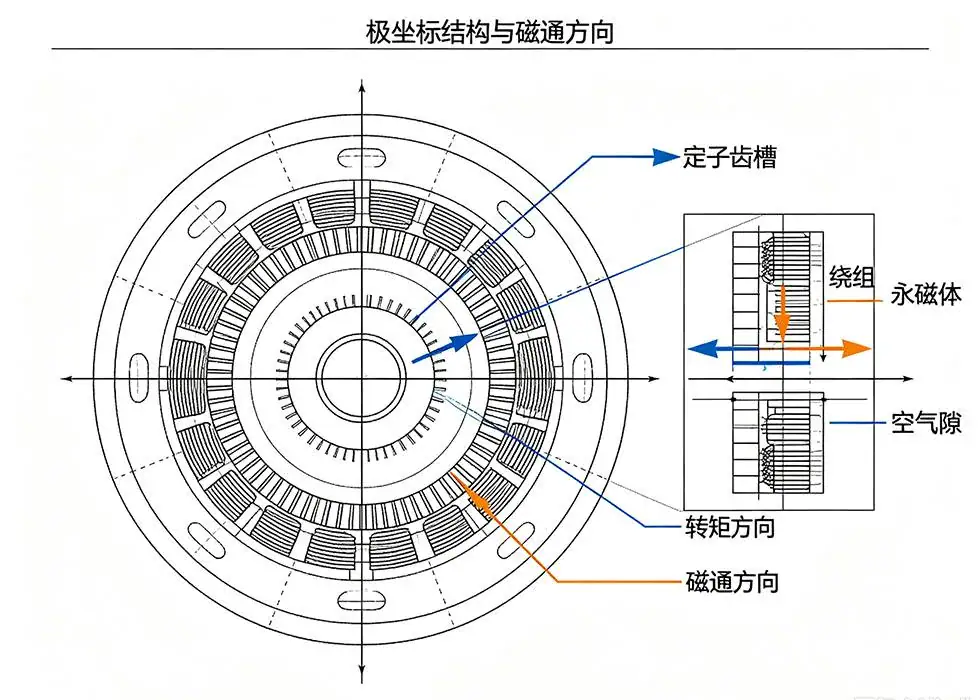
Polar Coordinate Structure and Flux Direction
The trouble is not only the material. In common topologies such as dual-rotor single-stator, the space inside the stator is narrow and a conventional winding needle simply cannot reach in; the only way is to wind the segmented teeth individually and then assemble them into a full disc. The segmented teeth must also maintain magnetic-circuit continuity and slot alignment, and any positional deviation of any piece is reflected in the air gap and back-EMF, imposing extremely strict requirements on assembly precision.
Axial-Flux Motor Section Structure
The stator and winding thus became the two unavoidable hurdles on the road to mass-producing axial-flux motors. In its related line solutions, Jiuju puts the most thought into the stator stage — how to stabilize the accuracy of segmented-tooth assembly, winding and joining — which tests process skill even more than magnet placement in the rotor stage. Whoever matures its stator process first holds the key to scaling this technology.
The shipping area outside the workshop was a hive of activity. After multiple rounds of full-machine commissioning, simulated mass-production validation, and factory quality inspection, a Jiuju DC motor automatic assembly line completed all factory-out procedures, was loaded onto trucks on schedule, and is about to depart for the customer's production base, helping the customer's project advance production implementation on plan.
A multi-pole architecture brings a high-frequency fundamental; at 10,000 rpm the fundamental frequency can reach several kHz. Traditional IGBTs suffer soaring switching losses and severe heating — it is the MHz-class switching capability of SiC MOSFETs that truly matches high-frequency multi-pole axial flux motors.
A multi-pole architecture brings a high-frequency fundamental; at 10,000 rpm the fundamental frequency can reach several kHz. Traditional IGBTs suffer soaring switching losses and severe heating — it is the MHz-class switching capability of SiC MOSFETs that truly matches high-frequency multi-pole axial flux motors.
A multi-pole architecture brings a high-frequency fundamental; at 10,000 rpm the fundamental frequency can reach several kHz. Traditional IGBTs suffer soaring switching losses and severe heating — it is the MHz-class switching capability of SiC MOSFETs that truly matches high-frequency multi-pole axial flux motors.
A multi-pole architecture brings a high-frequency fundamental; at 10,000 rpm the fundamental frequency can reach several kHz. Traditional IGBTs suffer soaring switching losses and severe heating — it is the MHz-class switching capability of SiC MOSFETs that truly matches high-frequency multi-pole axial flux motors.
 Jiuju Automation








 Spanish
 French
 German
 Hindi