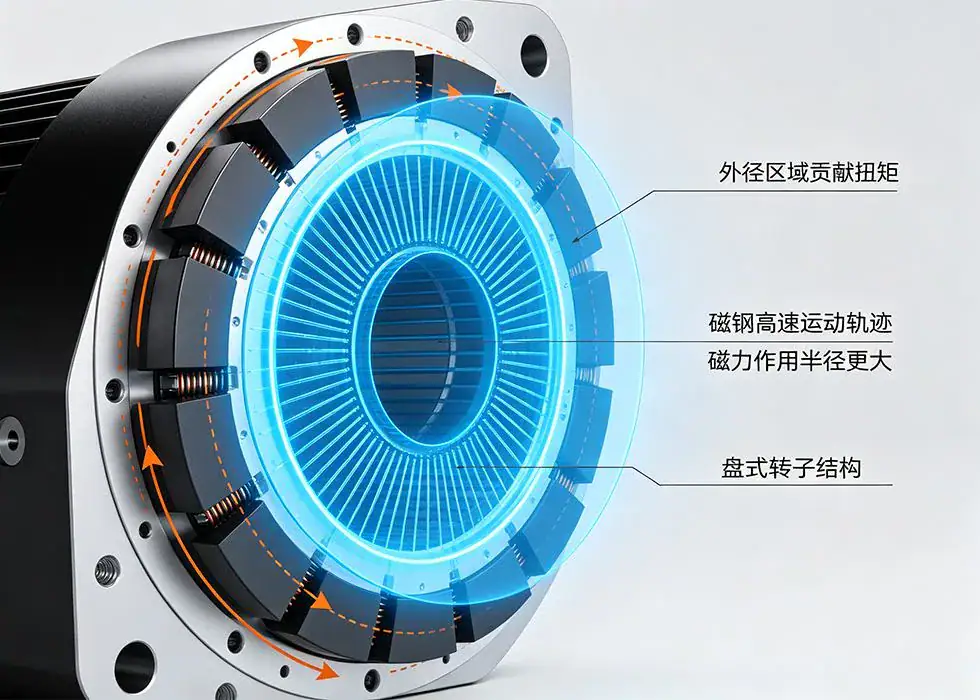
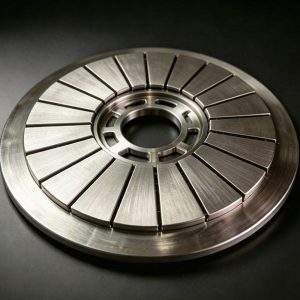
An axial-flux motor's magnetic force acts near the outer diameter, which brings high torque and also a hidden risk: at the same speed, the linear velocity of the magnets at the rotor disc's edge is far higher than in a slender radial motor, multiplying the centrifugal force.
Cross-Section View of High-Torque Principle for Jiuju Axial-Flux Motor
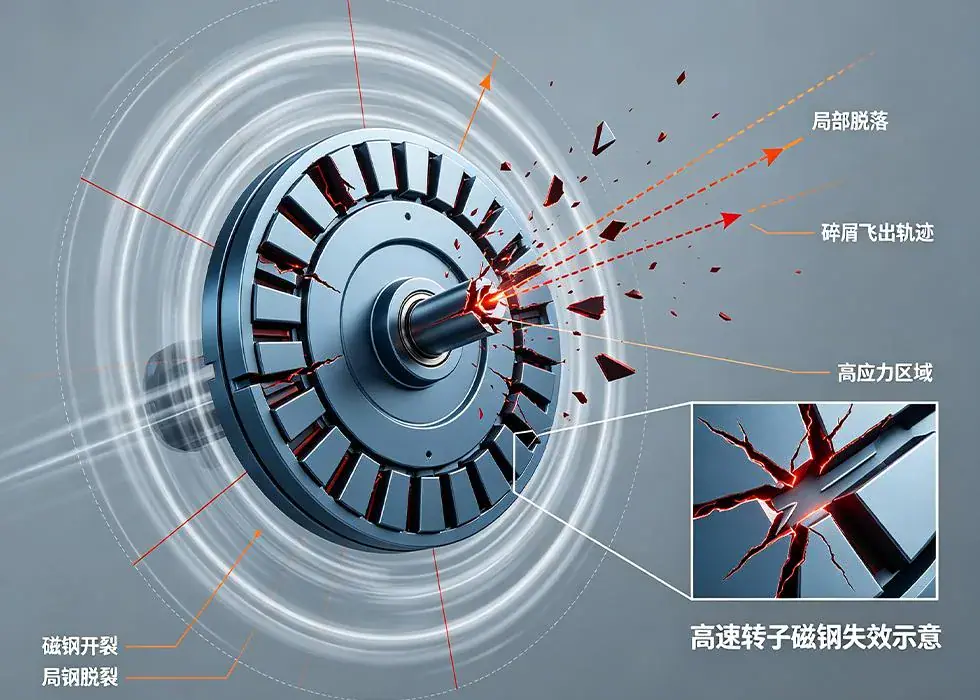
Note that centrifugal force is proportional to the square of the linear velocity; once the radius of action is large, this value grows very fast. For a motor of the same power, the axial-flux rotor disc has a larger outer diameter and thus a higher edge linear velocity. In genuine high-speed scenarios of tens of thousands of rpm, cases of magnets cracking or coming off the disc surface are not rare; once they come off, the rotor disc is scrapped outright and may even damage the stator.
Schematic of High-Speed Rotor Magnet Failure
So high-end axial-flux motors long ago stopped relying on simple surface bonding. A common approach uses three lines of defence: first wrap the magnets with carbon-fibre prepreg, then fit a high-strength non-magnetic metal sleeve outside, or simply make an embedded disc rotor so the magnets are set into the disc structure rather than bonded to the surface. Finally, dynamic-balancing weights ensure even force distribution across the disc at high speed. In fact, as early as the design stage, magnet segmentation and layout already pave the way for high-speed conditions — the more segmented and denser the pieces, the smaller the centrifugal force per piece and the easier to secure, at the cost of only more assembly steps.
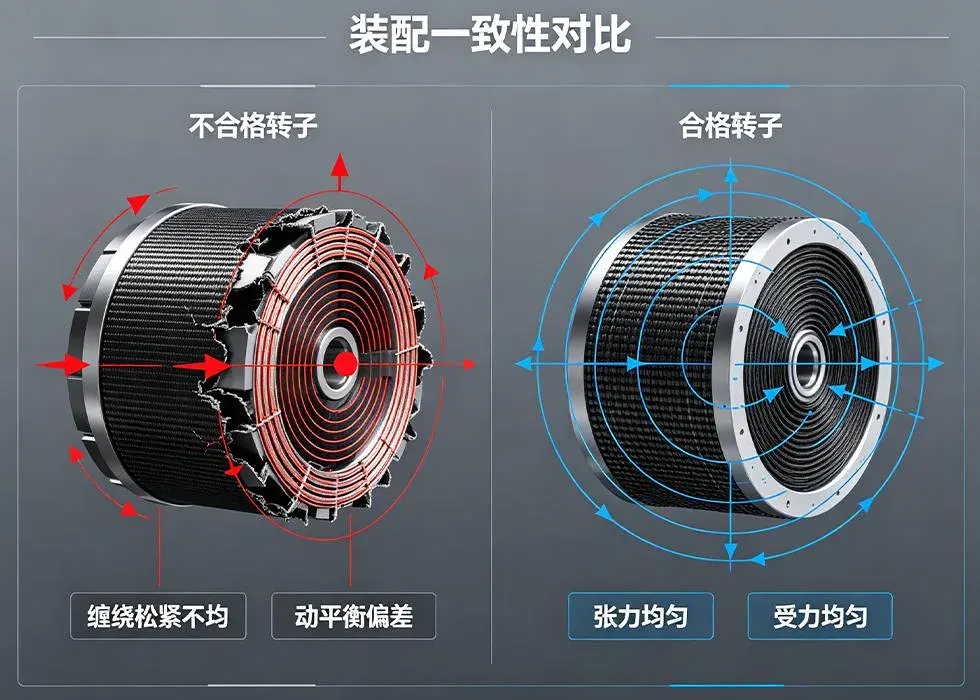
Jiuju Assembly Consistency Comparison
These approaches essentially digest the invisible opponent of "centrifugal force" into the structure in advance. Surface bonding is easy and low-cost but only suits medium and low speeds; once the speed rises, the packaging approach must change, and this money cannot be saved. When assembling such rotors, Jiuju attaches great importance to tension control and curing consistency of the sleeve and winding — if the carbon fibre is wound with uneven tightness, dynamic balancing becomes unstable, and any wobble at high speed is a hidden risk. Rotor reliability is half in the design and half in the uniformity of assembly.
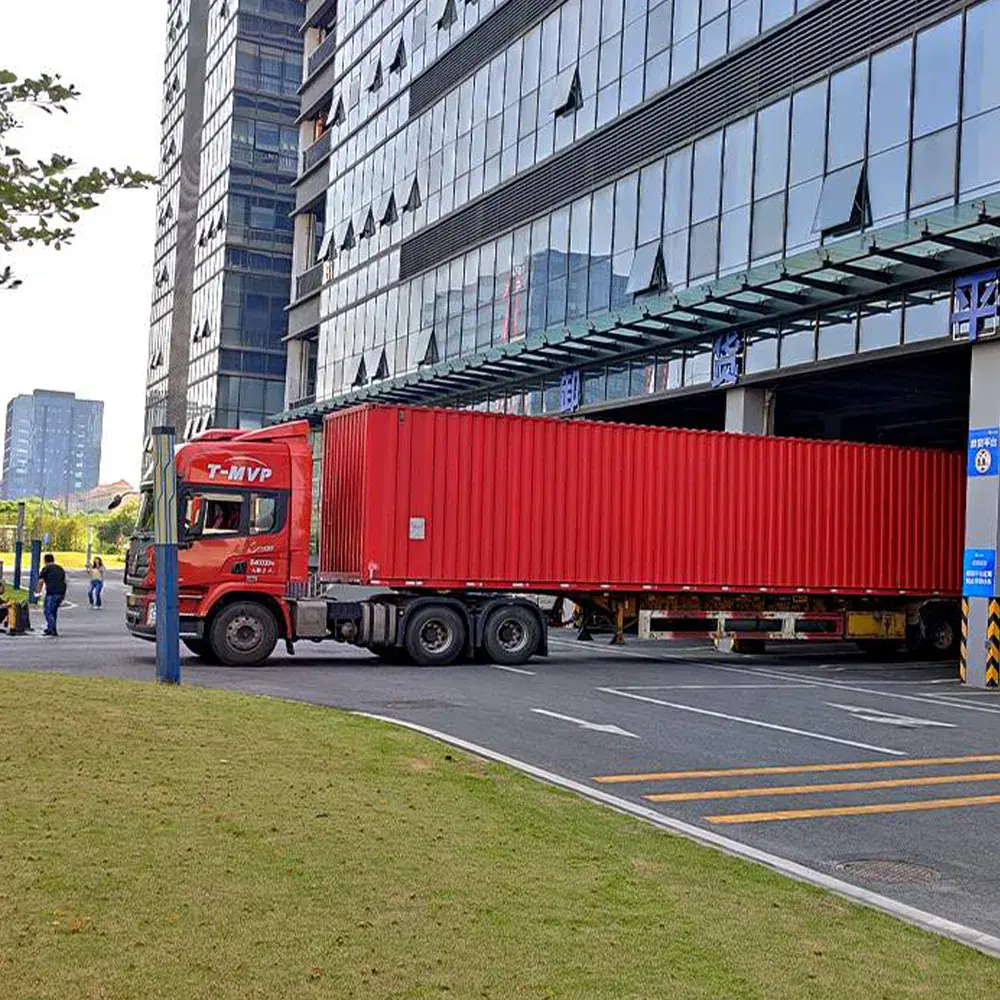
The shipping area outside the workshop was a hive of activity. After multiple rounds of full-machine commissioning, simulated mass-production validation, and factory quality inspection, a Jiuju DC motor automatic assembly line completed all factory-out procedures, was loaded onto trucks on schedule, and is about to depart for the customer's production base, helping the customer's project advance production implementation on plan.
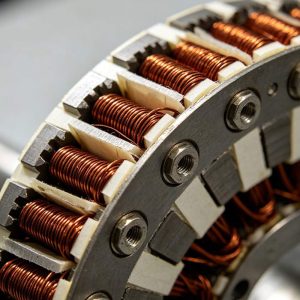
Magnetic flux must pass axially through the disc-shaped stator; traditional lamination stacking fails, and grain-oriented silicon steel ring-milled with slots destroys grain orientation. The stator and windings become the hardest nut to crack in axial flux mass production.
When the air gap is compressed to the millimeter level, the motor interior soars from room temperature to over 100°C during operation; aluminum housing, steel shaft, copper wire, and magnets have different expansion coefficients, and axial deformation may widen the air gap.
The stator and rotor are separated by a sub-millimeter air gap, and there is an axial attractive force of several metric tons between the magnets on both sides and the iron core. If the force on the air gap becomes uneven, the attractive force on one side increases exponentially, posing a severe challenge to the rigidity of the bearings and the housing.
High-performance NdFeB is indeed expensive, but an axial-flux motor's "cost per unit torque" does not lose out. It uses less magnet and copper material, and can even save the system a gearbox or battery capacity, making the overall BOM more cost-effective instead.
 Jiuju Automation






 Spanish
 French
 German
 Hindi