While new energy vehicles and robots are stealing the spotlight, industrial applications such as elevator traction machines, fans, and water pumps are quietly adopting axial flux motors. Here, the focus isn’t on flashy specifications, but on electricity bills and reliability at scale.
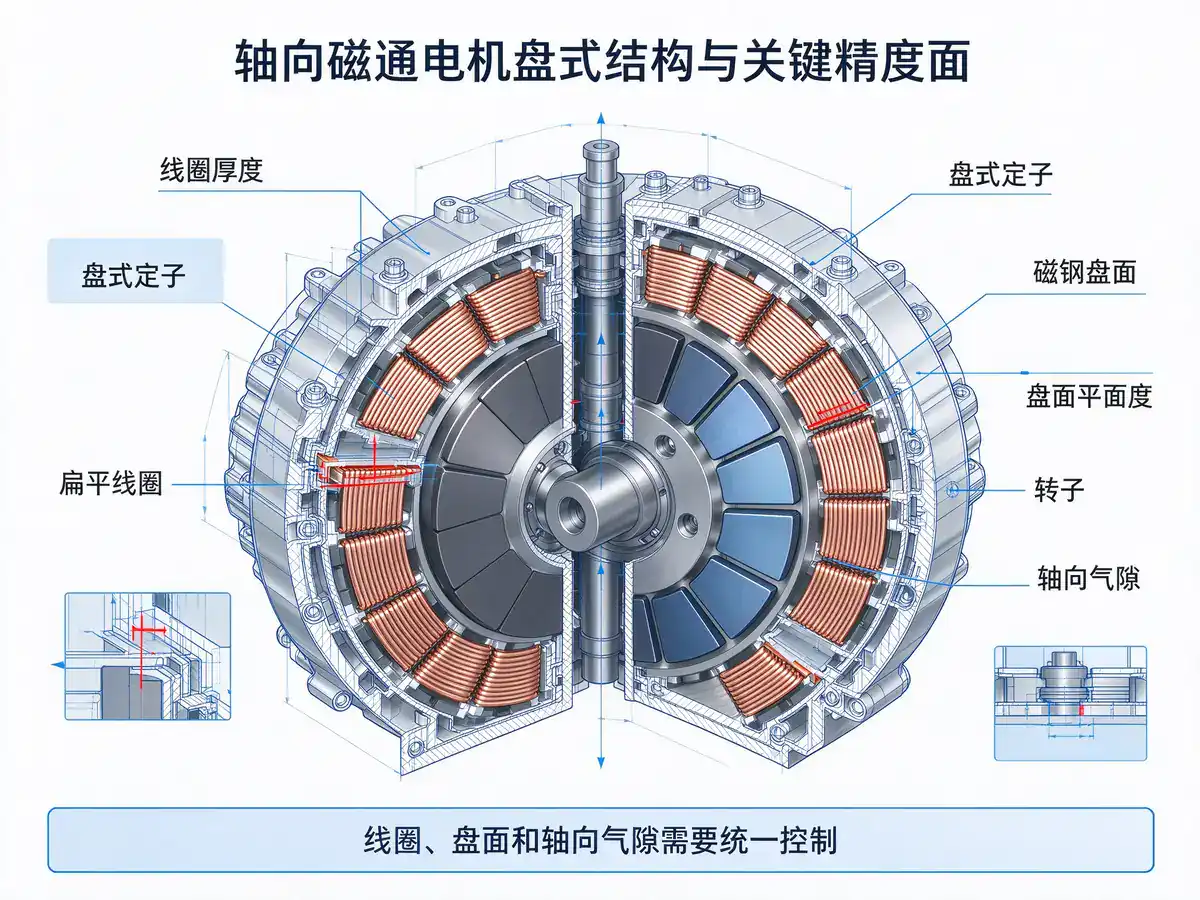
The performance of axial-flux motors is highly dependent on their spatial topology. This article analyzes four fundamental topologies—SSSR, DSSR, DRSS, and multi-disk stacking—as well as innovations in yoke-less and segmented stator designs.
Axial-flux motors offer significant performance advantages, but mass production requires overcoming three major challenges: air gap precision, thermal management, and cost consistency. This article analyzes the root causes and solutions for each of these challenges.
A multi-pole architecture brings a high-frequency fundamental; at 10,000 rpm the fundamental frequency can reach several kHz. Traditional IGBTs suffer soaring switching losses and severe heating — it is the MHz-class switching capability of SiC MOSFETs that truly matches high-frequency multi-pole axial flux motors.
 Jiuju Automation





 Español
 Français
 Deutsch (Sie)
 हिन्दी