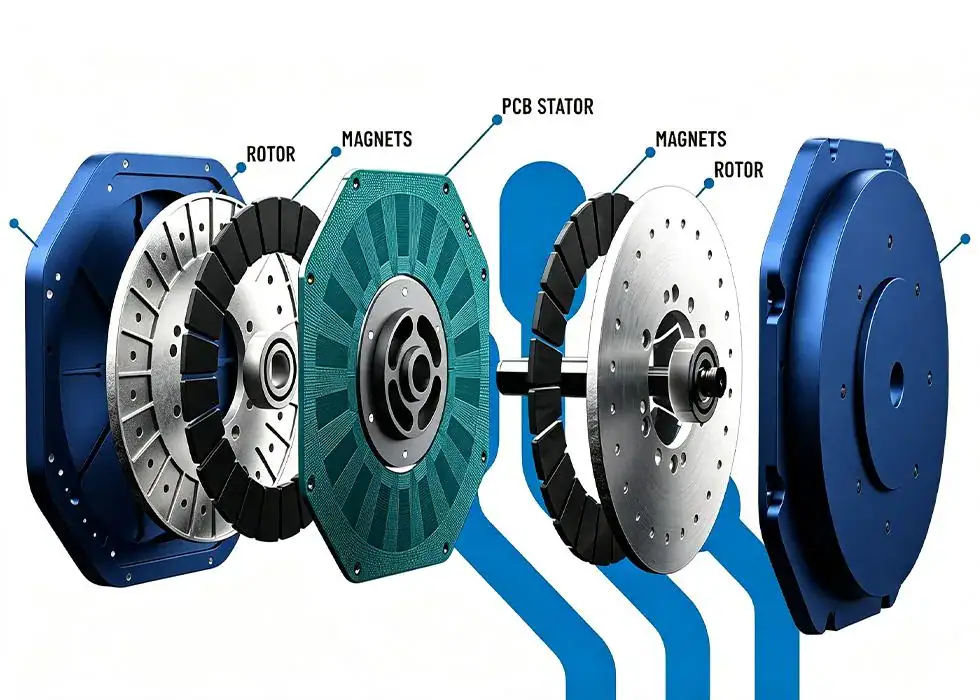
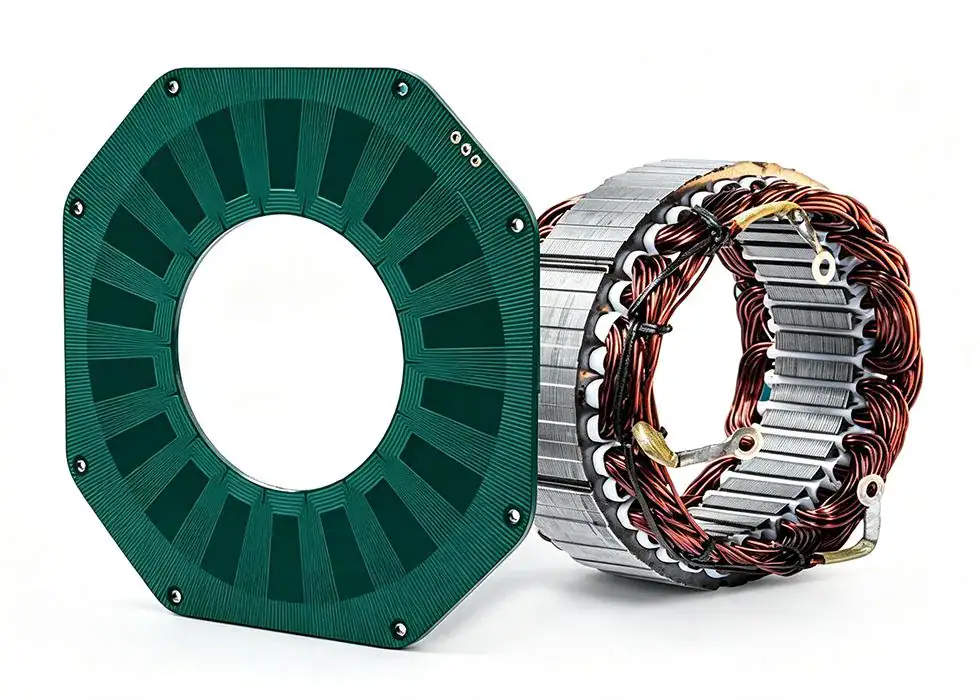
First, it offers higher energy conversion efficiency. The layout of the PCB stator windings can be precisely optimized using circuit design software, reducing end losses and interference between windings, thereby improving the motor’s overall energy efficiency. Second, it achieves significant weight reduction. By eliminating the traditional, bulky iron core structure, the overall weight of the motor is substantially reduced, making it better suited for weight-sensitive applications. Third, it operates quietly. Without the core’s cogging effect, electromagnetic noise and vibration are significantly reduced during operation, enabling near-silent operation. Fourth, it offers superior reliability. The stator windings are integrally molded with the PCB, and the manufacturing process is highly automated, effectively eliminating common failures associated with traditional windings, such as loosening and poor contact. Fifth, it offers high design flexibility. PCB stator solutions can be quickly customized to meet power and size requirements, shortening product iteration cycles.
Jiuju Automation provides high-precision automatic assembly lines for axial flux motors, covering processes such as stator winding, magnet assembly, rotor balancing, and final product testing. These lines are suitable for applications in drones, new energy vehicles, and industrial drives. The company holds over 256 patents and is ISO 9001 certified...
While new energy vehicles and robots are stealing the spotlight, industrial applications such as elevator traction machines, fans, and water pumps are quietly adopting axial flux motors. Here, the focus isn’t on flashy specifications, but on electricity bills and reliability at scale.
A multi-pole architecture brings a high-frequency fundamental; at 10,000 rpm the fundamental frequency can reach several kHz. Traditional IGBTs suffer soaring switching losses and severe heating — it is the MHz-class switching capability of SiC MOSFETs that truly matches high-frequency multi-pole axial flux motors.
 Jiuju Automation





 Español
 Français
 Deutsch (Sie)
 हिन्दी