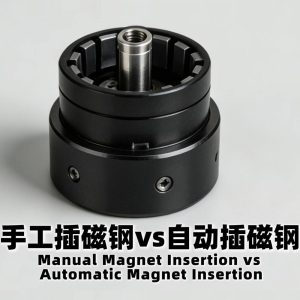
Traditional manufacturing and smart manufacturing outline the complete evolutionary path of drive motor manufacturing processes. Traditional production lines rely on manual auxiliary assembly and standalone machines. Processes such as magnet assembly, magnetization, and testing are fragmented and depend on manual calibration and positioning, resulting in poor consistency in dimensions and magnetic performance, low yield rates, and time-consuming changeovers—making it difficult to meet the mass production demands of today’s highly integrated, miniaturized motors. Smart manufacturing centers on integrated automated assembly lines, combining vision-based positioning, closed-loop magnetization, and in-line performance testing modules. It enables real-time data traceability throughout the entire process and controls critical operations—such as stator and rotor assembly and magnetic circuit magnetization—with micron-level precision, significantly reducing human error. Flexible production lines enable rapid switching between multiple motor models while simultaneously reducing material waste and labor costs. They perfectly support the implementation of new solutions such as SMC soft magnetic composite materials and axial flux motors, balancing high power density with large-scale cost reduction, and have become the mainstream direction for new energy electric drive manufacturing.
 Jiuju Automation



 Spanish
 French
 German
 Hindi