JiuJu Automation attended the first conference of CECC Inductor and Transformer Branch 2025 to build a new ecology for the industry.
As the global motor market demand continues to rise, the capacity bottleneck and quality pain points in the motor manufacturing process are gradually becoming the focus of industry attention. Among them, magnet steel assembly as the core process of permanent magnet motor production, long-term reliance on the traditional mode of manual operation, has been difficult to adapt to the current high-volume, high-precision production requirements. According to the latest industry data, in 2025, the market penetration rate of fully automated multi-station magnet insertion equipment has exceeded 40%, compared with 2022, an increase of 22 percentage points, the rapid popularization of this technology is reconfiguring the efficiency ceiling of motor production.
In the past, manual insertion of magnets is a typical labor-intensive process in the production of electric motors. Taking the 8-pole motor rotor as an example, it takes 3-5 minutes for a skilled worker to complete the assembly of magnets for a single piece of product, and due to the limitations of the stability of the manual operation, the yield of the product can only be maintained in the range of 85%-90%. At the same time, due to the strong magnetic properties of NdFeB magnets, manual operation is not only inefficient, but also there are risks such as magnet collision damage, magnetic poles installed in reverse, which further increases the hidden cost of production. The emergence of fully automatic magnet insertion technology has completely changed this situation.
Currently the industry's mainstream fully automated insertion of magnetic steel equipment, through the “vision positioning + force control detection + intelligent algorithms” triple technology closed loop, the assembly time of a single product is compressed to less than 25 seconds, the production efficiency has increased by nearly 10 times, while increasing the product yield to 99.5% or more. Part of the head of the equipment enterprise launched a multi-station cooperative equipment, but also to achieve the insertion and assembly efficiency of 1200 magnets per hour, a single machine can replace 3-4 skilled workers, and can support 24 hours of uninterrupted operation, significantly increasing the production capacity of the enterprise ceiling.
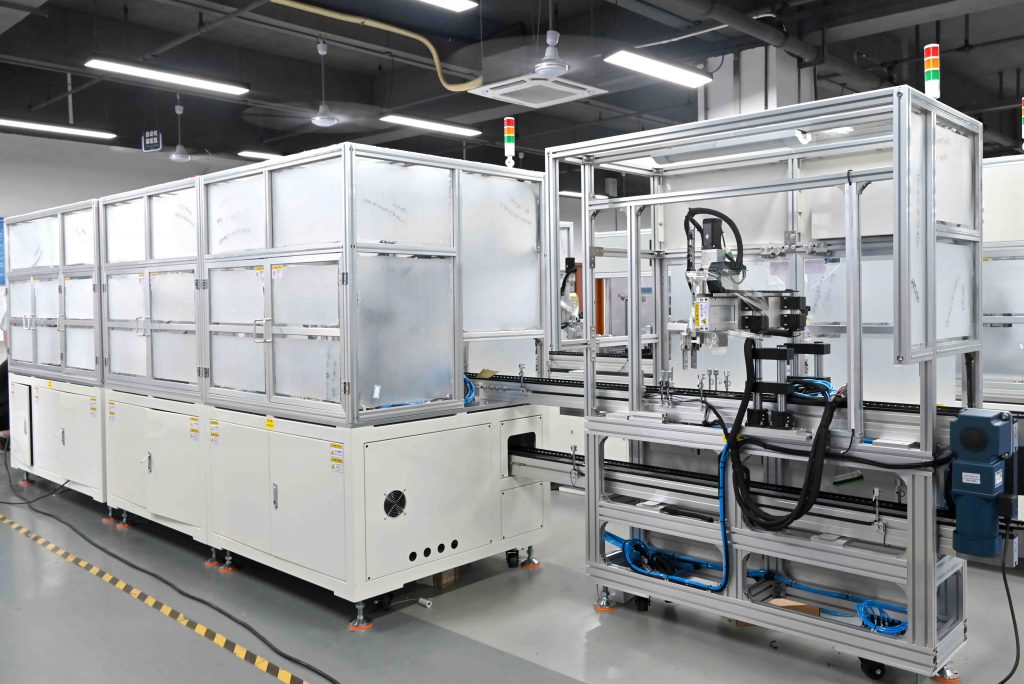
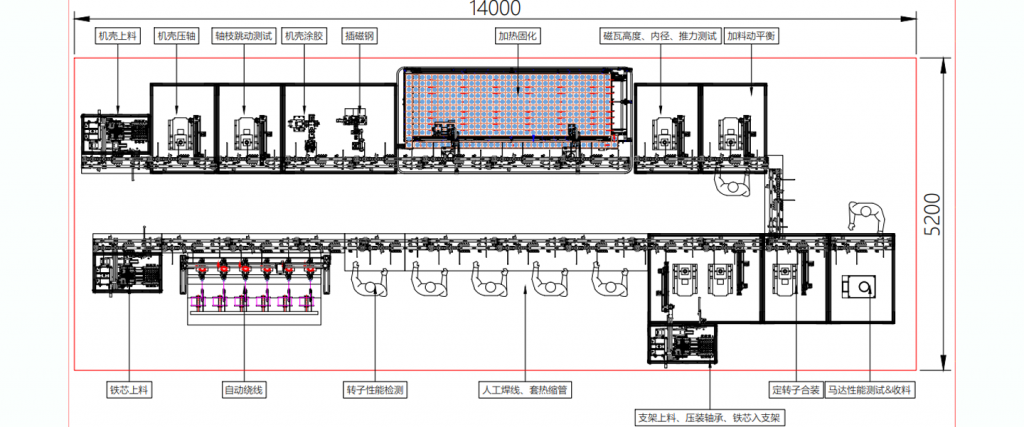
JiuJi - Brushless motor automated production line
In addition, the application of automation technology has also brought about a significant improvement in product performance. Through micron-level positioning precision control, the equipment can control the assembly error of the magnets within 0.05mm, making the magnetic field uniformity of the motor increase by more than 60%, which directly optimizes the motor's operating efficiency and noise performance. According to the relevant report of the China Machinery Industry Federation, the energy efficiency of motors using the fully automatic magnet insertion process has been improved by 2-3 percentage points on average, which is exactly in line with the requirements of the current national motor energy efficiency improvement program.
With the new energy vehicles, industrial robots, smart homes and other downstream areas of demand continues to explode, the motor industry's demand for capacity upgrades are still being released. Industry experts said that in the next two years, the penetration rate of fully automatic insertion magnet technology is expected to further increase to more than 60%, and become the standard process of motor manufacturing process, providing core support for the industry's high-quality development.
As the next generation technology of new energy vehicles, the industrialization of hub motor is accelerating, and breakthroughs in automated production technology are cracking the mass production problems of hub motor and promoting its commercialization.
Industrial robots, high-end equipment in the field of servo motor precision requirements continue to improve, the traditional rotor processing process of precision bottlenecks are being automated technology breakthroughs to promote the localization of high-end servo motors.
Home appliances, power tools in the field of brushless motor market demand continues to expand, the traditional insertion of the magnet steel process of production pain points gradually highlighted, automated insertion of the magnet steel technology is helping the industry to crack this problem.
Demand for small precision motors in the consumer electronics and micro-drive sectors continues to grow, and automated production technology is helping the industry to realize cost reductions and efficiencies, and to meet the demand for small-lot, multi-batch production.
 Motor automationmotorassembly